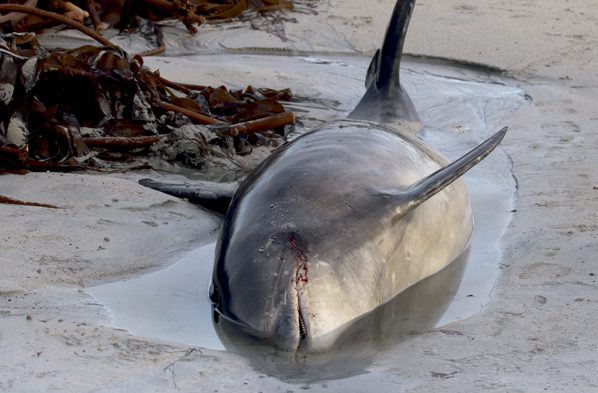
Finds on our beaches – cetaceans
Though the weather lately has been very variable, with longer days and good spells, more of us, residents and visitors alike, are out around our shores, especially beaches.
Some are fairly clean: seaweed accumulates in deep beds in some spots, rubbish of various sorts collects in corners or lies at intervals along the strandline.
Occasionally there is a dead cetacean – perhaps a tiny newborn Porpoise, about 80cm (2’6”) long or an 18m (60’) Sperm whale, or one of the other whales and dolphins that have been recorded here over the years. Some are very fresh and may have died after stranding; some may be decomposing, sometimes washing up as lumps of flesh and blubber with odd bones, or almost skeletal.
Recorded locally, in order of adult size, roughly, we see among the toothed cetaceans: Porpoises, Common dolphins, Euphrosyne or Striped dolphins, Atlantic White-sided dolphin, White-beaked dolphins, Risso’s Dolphin, Bottlenose dolphin, Pilot Whales, Killer whales or Orcas, Sowerby’s beaked whale, Cuvier’s beaked whale, Northern Bottlenose whale, Sperm Whale; and among the Baleen whales or Rorquals: Lesser Rorqual or Minke, Sei, Fin and Blue whales. In some species adult males can be considerably larger than the females.
Although it’s sad to see dead cetaceans, they can provide us with valuable information; not just what is alive in the sea around us, but information on each individual and the species, and some of the challenges they face, both natural and man-made.
Local trained volunteers who collect information and sometimes samples for the national recording scheme will try to visit every reported stranding. They pass on measurements and photographs of each animal, so, if possible, the length, girth, sex, any external evidence of damage such as scars or cuts, samples of skin, blubber and muscle from fresh carcasses and several teeth if appropriate. These provide DNA information, the types and levels of artificial contaminants and naturally occurring elements such as mercury that the animals are absorbing from their food. Tooth sections give away the age of the animal.
Gradually, these build a picture of our local populations and the threats they may face from chemicals released from household, industrial and agricultural activities, and from rubbish such as household plastics, or lost fishing gear, net and ropes.
If you find a dead cetacean (or turtle – they do come up occasionally) please e-mail the location, species (if you know it), and size, with a few photographs if possible, to reports@www.strandings.org, or phone 07979 245893. They will alert the local volunteers. If the animal is very fresh we may try to send it to them for a post-mortem, or if too large, they may come over to collect it or perform a post mortem on the shore.
Any live strandings should be reported with the same information as soon as possible to the SSPCA (03000 999 999) or British Divers Marine Life Rescue (01825 765 546). Covering an animal with wet seaweed will help to keep it comfortable while awaiting help. Make sure water does not go down the blowhole, and never drag an animal.
Mary Harman
Photographs are by Peter Keiller and Bill Neill