Benbecula’s role, eighty years on
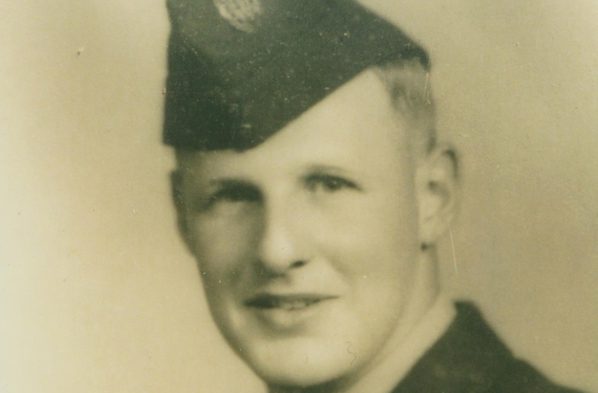
‘Jack Delarue was a very handsome bloke in his dark blue Aussie RAAF uniform. I flew with his crew to Ballykelly [Northern Ireland] in late September 1942 as part of a training exercise. 206 Squadron were “working up” on the mighty B17 Flying Fortress aircraft, which seemed so large and powerful. [The squadron had just converted from the smaller Hudson aircraft]. During the next couple of weeks squadron flying was hampered by atrocious weather. Then on 6th October – tragedy.’
This was Tom Blue from Glasgow, [later Ardrossan], talking to Mike Hughes about some poignant memories of his time at Benbecula during World War Two. Tom was groundcrew, a corporal driver in the RAF, but did get to make occasional flights. Tom dearly loved the island and made a number of return visits with other RAF veterans in the mid and late 1990s.
206 Squadron and later 220 Squadron were operating out of Benbecula as part of RAF Coastal Command. Late 1942 and early 1943 was a desperately worrying time in the war, as merchant navy ships bringing vital supplies to this country were suffering dreadful losses as they were relentlessly being sunk by German U Boats. Coastal Command and Royal Navy convoy escorts were engaged in a tremendous struggle to avoid us losing the war.
‘On October 6th, 6.00am, before dawn, Pilot Officer Jack Delarue and his crew had been given the “all clear” for take-off and they went thundering along the runway, fully fuelled, gunned and depth charged. Roaring halfway down the runway at full throttle, they had to make a sudden violent climb to avoid another aircraft which came into view in the darkness, taxying toward them. Poor Jack and his co-pilot had to pull back on their controls with all their might, in a desperate attempt to avoid the other “Fortress”. They did, merely breaking an aerial. However, they did not have enough power to complete take-off, and after climbing only a few feet, all four engines cut out, and they dived onto the end of the runway, bounced and went careering on to the rocks and finally came to rest some 50 yards into the sea.’
‘Two crewmen located nearer the rear of the fuselage were thrown clear, or managed to scramble from the wreckage, but five brave men were lost. Some bodies were eventually pulled from the mangled Fortress and others were “given up” by the sea over the next couple of weeks. One chap was never found. When daylight broke the huge tail fin stuck out of the water like a stranded whale. About a quarter of the fuselage was above water. I got my tanker, which had a huge metal hawser cable and hook, for rescuing aircraft which became bogged down on grass. Two Royal Navy divers had arrived and I fed my cable to their boat. They rowed out and attached balloons to keep the aircraft from slipping into deeper waters and becoming completely submerged. I watched with tears in my eyes; such a happy bunch of chaps, their lives obliterated at such an early age.’
On that night, exactly eighty years ago, a tremendous commotion followed the sound of the aircraft crashing. Two extremely brave officers, Flight Lieutenant Willis Roxburgh and his co-pilot Flying Officer Johnny Owen rushed to the beach overlooking the site of the horrendous accident. In his haste, in almost total darkness, Roxburgh stumbled in the sand dunes and dislocated a thumb, but he and Owen continued on, stripped off their uniforms and did all they could to swim out to the crash scene to try to rescue their colleagues. Sadly, the extreme cold and incoming tide drove them back to shore. Along with Jack Delarue, those who perished were Sergeants Jaeger [2nd pilot], Robinson, Guppy [RAAF] and Taplin [RAAF]. The survivors were Sergeants Coutts and Hunt, who got ashore in a dingy.
The pilot on the other aircraft involved that night was Bob Cowie. Bob also returned to the island for an RAF reunion in 1995. I recall he cut a forlorn figure at the remembrance service at Nunton cemetery. However Bob became much more relaxed after attending that service, and was adamant he had in fact received a signal from the control tower, that fateful dark night, that he was to proceed onto that runway. He was certain the mistake was not his. After the accident Bob Cowie was actually given the order to take off with his crew at 7.00am on 6th October. No time for stress counselling in those days.
Bob continued operating from Benbecula and sank a U Boat on 27th of October, only three weeks after Jack Delarue was lost. He then sank another in April 1943. Bob Cowie was a most distinguished airman, finishing up with a DFC and the rank of Squadron Leader. Jack Delarue had already given outstanding service while attached to 206 Squadron [from the Royal Australian Air Force]. He might have been considered for an award for his actions on 6th October alone, when he undoubtedly prevented the loss of lives in Bob Cowie’s crew. The fortunes of war.
Willis Roxburgh [a Scotland rugby international] went on to sink a U Boat in March 1943. Johnny Owen amazingly, attacked three U Boats in the one operational ‘sortie’, flying from Benbecula on 11th December 1942. Three days later, on 14th December, he and his valiant crew were lost without trace on another anti-U Boat hunt. In total, B17 Flying Fortresses operating from Benbecula made no fewer than 14 successful attacks sinking or damaging U Boats. A remarkable contribution to victory in the Battle of the Atlantic.
Willis Roxburgh wrote ‘Jack Delarue was a very good pilot and immensely popular on the squadron. I well remember forming up behind the simple gun carriage and slow marching up the hill to the little cemetery. The local RC Padre took the service and he was really excellent. We all retreated to the Officers’ Mess afterwards under his leadership.’
Tom Blue remembered: had come such a long way to help us. I was there when they laid those lads to rest in the small graveyard. I was determined to return one day to Benbecula to pay my respects’. Tom did so, three times, and was so fulsome in his praise of the reception given by islanders the RAF stationed on the island at that point. Sorry to say, I, in turn, lost a great friend when Tom Blue passed away. I miss him a lot. If you are passing Nunton, perhaps visiting a relative’s graveside, why not pause a while, remember these boys who came here during World War Two, some of whom remained. Perhaps you might say a wee thanks for your liberty, and maybe a wee prayer, if you are inclined.

By Mike Hughes, author of: Hebrides at War; Stornoway in WW2; Tiree, War Among the Barley and Brine.
Mike lives in Lanarkshire, is married to Barbara who has strong Hebridean and West Highland connections. He is a father and grandfather, is a retired teacher and has a great love of the Hebrides.
Mike would be delighted to hear from anyone with memories or information relating to the Western Isles during World War Two.