Uist fact-finding mission for Holyrood Committee
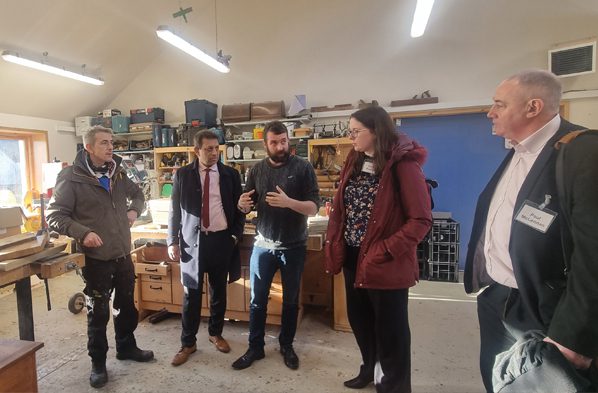
The Scottish Parliament’s cross-party Committee for Social Justice and Social Security visited Uist last month to find out more about the difficulties local working parents face in finding suitable childcare provision.
At a well attended meeting at the Cothrom Adult Learning Centre in Ormiclate, parents shared their experiences of balancing the need to earn a living with the requirement to find suitable childcare, highlighting the many barriers they faced in returning to work.
Commenting on the meeting, Cothrom Òg Manager Ceiteag MacDonald said: “It was a positive and very constructive session, with parents representing a wide range of different employment circumstances attending. The Committee members were clearly here to listen and everyone had a chance to air their views.
“Both as a parent and as the Manager here at the nursery, I am very aware of the issues facing those who are trying to juggle work and childcare demands. Costs can be prohibitive, where employers are able to offer flexible working arrangements it can greatly help parents access childcare that works for them. Equally, it can be a clear barrier to parents returning to work, or parents sharing childcare responsibilities, if that flexibility is not available or applications for it are rejected.
“Childcare providers in Uist currently don’t always have capacity to meet the demand, which is very difficult for parents and also it can be an issue if public transport doesn’t meet the needs of someone looking to access employment or childcare, which can often be the case.”
In Scotland, funded early learning and childcare is available for all three and four year olds, but for the majority of children aged two and under, childcare is funded from the parents’ own purse.
Working parents will be eligible for up to a year’s worth of parental leave, and although that option means a loss of earnings, it does offer some protection. But it is once that period of leave concludes, then the real issues start and parents find themselves weighing up the value of working against the difficulties of not only finding childcare but paying for it. People often rely on a network of family support, but for people who have moved into the area this is not always an option.
Another key issue aired by the parents was the difficulty of finding suitable and affordable transport. Not everyone has a car and for those without, public transport is not always available when it is needed. As one contributor said: “If you don’t have a car then island life is utterly limiting.”
The discussions not only highlighted the challenges but set out potential solutions that could allow more parents to return to work, or commit to longer hours.
Examples of this solutions-based thinking included the opportunity to improve transport. Currently school bus provision only extends to journeys to and from school and not all children are eligible; extending provision to allow children travelling between school and nurseries a free seat would allow for easily accessible wraparound care and ensure parents did not have to leave work at 3pm to pick up their child from school and drop him or her off at the childcare provider.
Emma Roddick, MSP for Highlands & Islands and Deputy Convener of the Social Justice and Social Security Committee, said: “We came to Uist to learn how child poverty and difficulties in finding employment differ in the islands compared to the mainland. Thank you to the parents, local employers and organisations who took the time to talk to us.
“The personal stories that parents have told us about the challenges of finding childcare that was either close to home or close to work have helped to highlight a particular challenge that we need to consider for people in the highlands and islands. We need to consider how we ensure communities which are a little more spread out than they are in other areas have access to the kind of infrastructure to help them access good jobs and the right kind of childcare.
“The local employers and organisations that spoke to us are playing a key role. Their shared knowledge of what they and parents on Uist need is going to be useful in helping us craft our recommendations for the Scottish Government.”
Committee members also held meetings at An Caladh in Balivanich and Cnoc Soilleir in Daliburgh, talking with employers, education providers and community groups about the wider recruitment and retention issues in Uist, with a view to better understanding what role childcare could play in getting more vacancies filled.
The Committee plan to launch a call for views on this subject in February to allow people who were unable to attend the meetings to share their views online.
The hope is that the Committees will galvanise efforts both locally and nationally with a view to making life easier and more affordable for working parents.