Small is beautiful: new report highlights the scope for growing Uist’s sustainable food options
Tagsa Uibhist has newly published an in-depth report on the opportunities and challenges of building a more resilient and sustainable local food system for Uist.
The report was commissioned by the Pebble Trust in 2022 and delivered by Tagsa’s Research & Development Officer Alex MacKenzie following months of intensive community research.
The report is part of Tagsa’s Small is Beautiful project and looks in detail at how we currently source our food and at the challenges and opportunities around finding a better, more affordable and sustainable way forward.
The report is clearly set in a wider context of the climate emergency, increasing levels of food poverty and the many failings of industrial food production, as well as our more local issues with travel and distribution disruptions.
Alex told Am Pàipear more about the project:
“Despite producing substantial quantities of food, the islands face acute food insecurity, and more so than on the mainland.
“A clear finding from our research is that people in Uist are committed to finding a better way of producing and sharing local food. We also found that there is demand from the local community for high quality and affordable local produce – vegetables, meat and seafood.
“A resilient local food system in Uist will simultaneously support the local community and culture as well as contribute to economic and environmental sustainability. Achieving this will require supporting islanders to make optimal use of their land, its assets, and its benefits to prioritise local production and consumption.”
The report sets out some clear and compelling community recommendations to take the work forward, with an emphasis on sticking to the ‘small is beautiful’ approach, to ensure that projects are rooted into the community and evolve slowly under the guidance of community members.
The report makes clear that producers wanted to be part of a local food network to aggregate and market food locally, and saw benefit in creating a system of collaboration where everyone benefits.
Suggested opportunities included a Uist Local Food Market, Local Food Box Schemes and Community Fridges.
The demand for high quality, locally-reared meat was clear and the report suggests that more could be done to support and incentivise crofters to sell their animals locally.
Another option was to assist local growers to access procurement opportunities from Comhairle nan Eilean Siar and the NHS, for example for school meals and hospital cafeterias, so that local potatoes, vegetables, meat, eggs, and fish can be purchased locally.
Alex continued: “Islanders understand and appreciate the entire farm-to-fork process. They also have the lived experience of rearing, nurturing, cultivating, and sourcing the many inputs required to just get to the first stage in the chain, before food processing is even contemplated. They have a close connection to the land, sea, and all the island’s natural resources. This engenders a respect and a gratitude for the environment, which runs through the arteries of the community. Being a food producer proves to be a labour of love for some, a way of being, fulfilling a tradition or a lifestyle choice to be able to produce your own food and eat it. The true cost of food production is never reflected in the price of the goods in terms of the energy, time and care involved so it comes as no surprise that producers here see food waste as a crime.”
As Chris MacLullich, Chief Executive, Tagsa Uibhist explains, the timing of this work could not be better: “This is an auspicious time to be working to improve our food systems in Uist. At a local level, the Outer Hebrides Food and Drink Programme under the Islands Growth Deal offers an enormous opportunity to invest in local food value chain systems by engaging directly with local producers. The Scottish Government’s Good Food Nation Bill, which aims to make positive changes to how we grow, produce, and consume food has just been passed. It is vital for communities, consumers, organisations, and businesses to continue to advocate so that this Bill has a meaningful impact. This means enshrining the Right to Food for all by reducing food insecurity, establishing an independent Food Commission, agreeing meaningful targets for changes to the food system, and establishing funded Food Plans at a national and local level through a participatory process.”
The full report makes for an inspiring read and is available to view on the Tagsa Uibhist website.
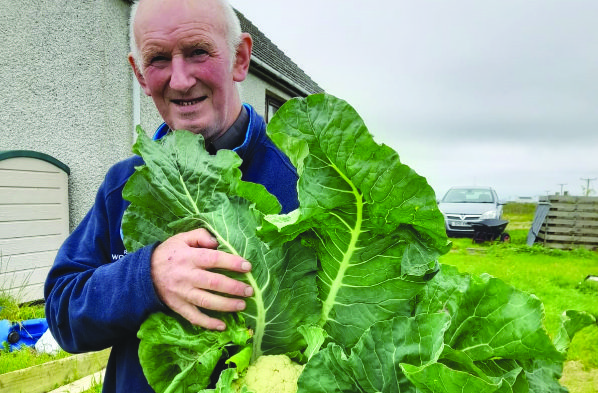
Pictured is Donald MacQueen of Iochdar.