A.I. technology trialled against a supersonic missile threat
Abigail Taylor
For the first time, artificial intelligence (A.I) is being used by the Royal Navy at sea as part of exercise Formidable Shield, which is taking place off the coast of Scotland.
This operational experiment on the Type 45 Destroyer (HMS Dragon) and Type 23 Frigate (HMS Lancaster), is using the A.I. applications, Startle and Sycoiea, which were tested against a supersonic missile threat.
As part of the above water systems programme, led by Defence Science and Technology Laboratory scientists, the A.I. improves the early detection of lethal threat, accelerates engagement timelines and provides Royal Navy Commanders with a rapid hazard assessment to select the optimum weapon or measure to counter and destroy the target.
Defence Science and Technology Laboratory Programme Manager, Alasdair Gilchrist MBE said: “Dstl has invested heavily in the systems that are installed at the moment, but it’s imperative that we continue to invest to make sure that the Royal Navy remains relevant now and in the future.
Being able to bring A.I. onto the ships is a massive achievement, and while we can prove the A.I. works in the labs, actually getting Navy personnel hands on is brilliant.”
As outlined in the recent Defence Command Paper, the MOD is committed to investing in A.I. and increased automation to transform capabilities as the Armed Forces adapt to meet future threats, which will be supported by the £24bn uplift in defence spending over the next four years.
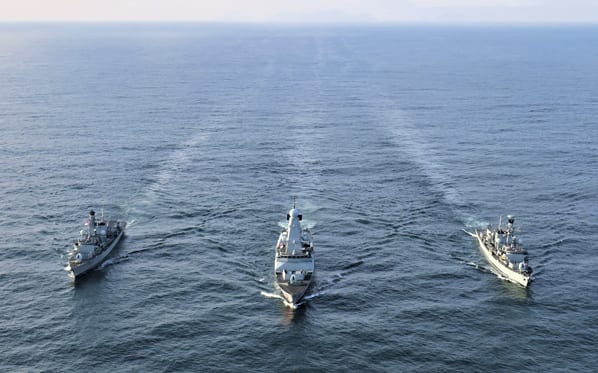
HMS Lancaster and HMS Dragon (pictured above) are currently trialling the use of A.I. as part of a glimpse into the future of air defence at sea.