So much has happened, so little has changed
“Our life line ferry services are failing us.”
This same message has been communicated so often and by so many different voices: Audit Scotland, the Scottish Parliament’s own Net Zero, Energy & Transport Committee, elected members in Westminster, Holyrood and our own Comhairle, business groups, trade bodies and ordinary citizens on the mainland and here in Uist, where lives and businesses have been so severely impacted. Everyone is saying the same thing.
To quote from the recently published parliamentary report on requirements for A Modern and Sustainable Ferry Service for Scotland, our current system is ‘a recipe for confusion and buck-passing that cannot be allowed to continue’.
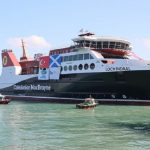
As Am Pàipear went to print, the MV Lord of the Isles (LOTI) was back on the Lochboisdale run, ending a month-long loss of service with all its terrible associated costs and impacts. Although good news, the return of the Lochboisdale service doesn’t herald an end to Uist’s ferry troubles.
LOTI is 34 years old and despite being well past her life expectancy, no formal tender has been issued for her replacement.
Cllr Uisdean Robertson expressed his concerns: “Although the initial design phase for a new vessel has begun, Scottish Government has reiterated that there will be no capital funds available for this or any other project before 2026. Even if funding does get allocated at that point, it will be a further three years of tendering and commissioning before a replacement vessel sails into Lochboisdale harbour, by which time LOTI will be near on 40 years of age.”
This slow progress has left many asking, if things are problematic now, how might they be looking by then?
Cllr Robertson continued: “What we need now is the early release of those funds to allow the work to replace LOTI to get underway.”
Resilience will be tested again this winter when Uig pier closes on 30th October for the second phase of planned works, leaving Uist more dependent on the Lochboisdale Mallaig service, which, even with a vessel in full working order, runs an average service cancellation rate of 30%.
With eight even older vessels in the fleet and the replacements on order still a long way off, it won’t be long before the ‘Magic Matrix’ is consulted once again.
The ‘matrix’ route prioritisation process that CalMac follows when deciding how to mitigate for the unexpected loss of a vessel has been the subject of much discussion.
Last year, CalMac published an overview of their approach to route prioritisation but it lacked the detail that would allow a better understanding of how these decisions are made.
Am Pàipear asked to see the details of the specific scoring exercise that led to the decision to leave Lochboisdale without a boat for almost all of June. The document CalMac returned provides more detail on the scoring process and some insight as to how it is that Uist is so often on top of the hit list for service disruptions.
CalMac says that the impact of each decision is rated against seven factors, with scores ranging from 5 (critical) to 1 (insignificant). Each route is given a ‘baseline score’ which considers the availability of alternative transport, the impact of those alternatives on journey times and the frequency of the timetabled service; these criteria are scored and then multiplied by the average number of cars in the previous season. Each specific incident is also given a ‘dynamic score’, which factors in local events taking place, the extent of the disruption, historical disruptions and any disruptions to the alternative services. The total score guides CalMac’s decision, but is ‘not prescriptive and is used alongside other tools including contingency and resilience plans’.
The document issued to Am Pàipear also details alternative options CalMac discounted before deciding to take the LOTI off its usual run: “Each of these options was weighed against the decision to cancel the Lochboisdale service, which included estimating the number of vehicles that would be disrupted, evaluating the capacity of neighbouring services to manage the displaced traffic, and identifying opportunities to supplement neighbouring services to mitigate any impacts as far as possible. Given the number of displaced vehicles was expected to be in the region of 2,500 (when compared to Mull with 6,600 or Islay with 7,600), and since there was capacity on neighbouring services to carry the displaced traffic, the decision was taken to cancel Lochboisdale.”
Only time will tell if the additional consideration of ‘negative media attention’ will be factored into future scoring exercises.
When the Ferry Impact Group demanded a guarantee that, weather permitting, the Lochboisdale service would not be impacted by further disruption, new Transport Minister Fiona Hyslop said she would consider it, promising to report back after discussions with CalMac.
Gail Robertson, Uist representative on the Ferry Community Board (FCB) told Am Pàipear: “Although we were aware of a Matrix, we had had no prior input into the principles and processes used. From our perspective, the use of numbers of travellers as a means of deciding priority presents a danger for islands relying on lifeline services. An alternative is only an alternative if it has capacity.”
The FCB has also expressed concern over the new ticketing system, which failed catastrophically within days of launching: “Over the last 18 months, we have offered to test the system but have not been included in that process. We continue to worry about effective outcomes of the system and are very aware of the added pressure on front line staff. ”
Despite this and other failings, the dreadful news coverage, the march through Glasgow city centre, the Lochboisdale protest, the political and public fury, the near-unanimous and wholly unequivocal vote of no confidence issued to CalMac in Southend Hall last month, it has been deemed very likely that CalMac will have their contract renewed and extended when current arrangements end in September next year.
In its Report, the Net Zero, Energy and Transport Committee concluded: “We understand that these recommendations carry a likely outcome of a 10-year direct award to CalMac.”
There are a number of island groups now in discussion with Scottish Government to ascertain the viability of alternative contract arrangements, although the timescales are now considered desperately tight.


MOVERS, SHAKERS AND HEADLINE MAKERS.
It’s been a busy few weeks when it comes to ferry news:
- At the end of May, Kevin Stewart, the then minister, visited Uist and pledged to improve the service.
- Days later, LOTI was taken away with no warning and little support other than a handful of additional services over the small sounds.
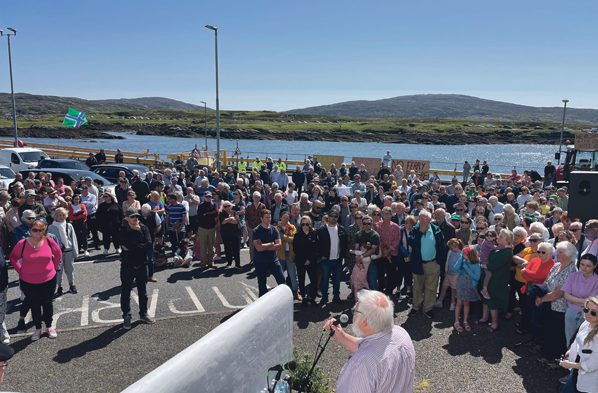
- On 4th June, the Lochboisdale protest attracted a crowd of over 500, making national news headlines. Soon after, Mr Stewart resigned, with Fiona Hyslop taking up the vacant role a week later.
- On 12th June, CalMac CEO Robbie Drummond was in Uist, visiting island businesses and meeting members of the public. There was to be a public meeting and then there wasn’t to be a public meeting.
- The following week there was a public meeting. On 20th June, around 250 members of the public gathered in Southend Hall and delivered a heartfelt vote of no confidence in the CalMac senior team.
- On 24th June, our Uist diaspora took to the streets in Glasgow to show their support and once again, Uist was in the national news.
- On 29th June, new Transport Minister Fiona Hyslop met with community representatives including John Daniel Peteranna, who told Am Pàipear: “We had a very positive meeting with the Minister and are looking forward to her coming back to us with some progress soon.”
- LOTI was back on her usual run that same day.