
Highlands and Islands Airports Limited (HIAL) has confirmed its intention to scale back its controversial Air Traffic Control modernisation plans in response to ‘the funding challenges facing the country and the Scottish Government’s broader strategic spending review’.
HIAL first announced plans to remove Air Traffic Control (ATC) operations from Benbecula and Wick Airports in January 2020, stating that it was a necessary response to changing regulatory requirements. If pursued, the plans would have seen the the loss of skilled jobs and the potential for service disruptions.
HIAL’s U-turn is expected to provide a final reprieve for Benbecula Airport, and follows an earlier, less resolute stay of execution announced in March last year in response to sustained community pressure.
HIAL now states its future plans for ATC are still to be confirmed: “The HIAL Board remains in dialogue with Transport Scotland regarding the reduction of funding and its effect on frontline service delivery.”
Benbecula Community Council, working with the Uist Economic Task Force, led the campaign to save Benbecula ATC, raising public awareness of the safety risk the decision presented and petitioning Scottish Government, which owns HIAL, to intervene and get the decision overturned.
The campaign highlighted the lack of local representation on the HIAL Board and led to the submission of a petition to Scottish Parliament demanding that the public bodies delivering lifeline services to island communities should have representation from those communities on their Boards.
The petition argued that local knowledge should be viewed as an essential skill for the Boards of organisations accountable to the Scottish Government, saying: “Such knowledge would bring an appreciation and understanding of local community needs relevant to the service which is being delivered. In particular, we believe that local knowledge will bring insight into economic and infrastructure development, local investment and planning, employment, housing, education and health and social care and how these relate to the service the public organisation provides.”
The Uist Economic Task Force highlighted the impact this could have had on the HIAL decision: “HIAL is one example where this change could be applied. Its Board meets regularly to provide strategic direction for the company and is responsible for the determination of the company’s strategic plan and direction. In particular, the Board reviews safety, security, risk management, corporate governance, operational matters, financial management, business and commercial strategy, route development, pay, pensions and human resources.”
David MacBrayne, which owns and operates CalMac, provides another such ‘lifeline’ service under the direction of a Board with no local representation.
Air Traffic Control reprieve
Categories: News


Latest News
- CMAL secures ownership of remaining Cemre vessels to protect delivery for island communities
 Caledonian Maritime Assets Limited (CMAL) has taken ownership of the three… Read more: CMAL secures ownership of remaining Cemre vessels to protect delivery for island communities
 - Island dancers set for North Carolina
 This July, two young dancers from the Outer Hebrides are… Read more: Island dancers set for North Carolina
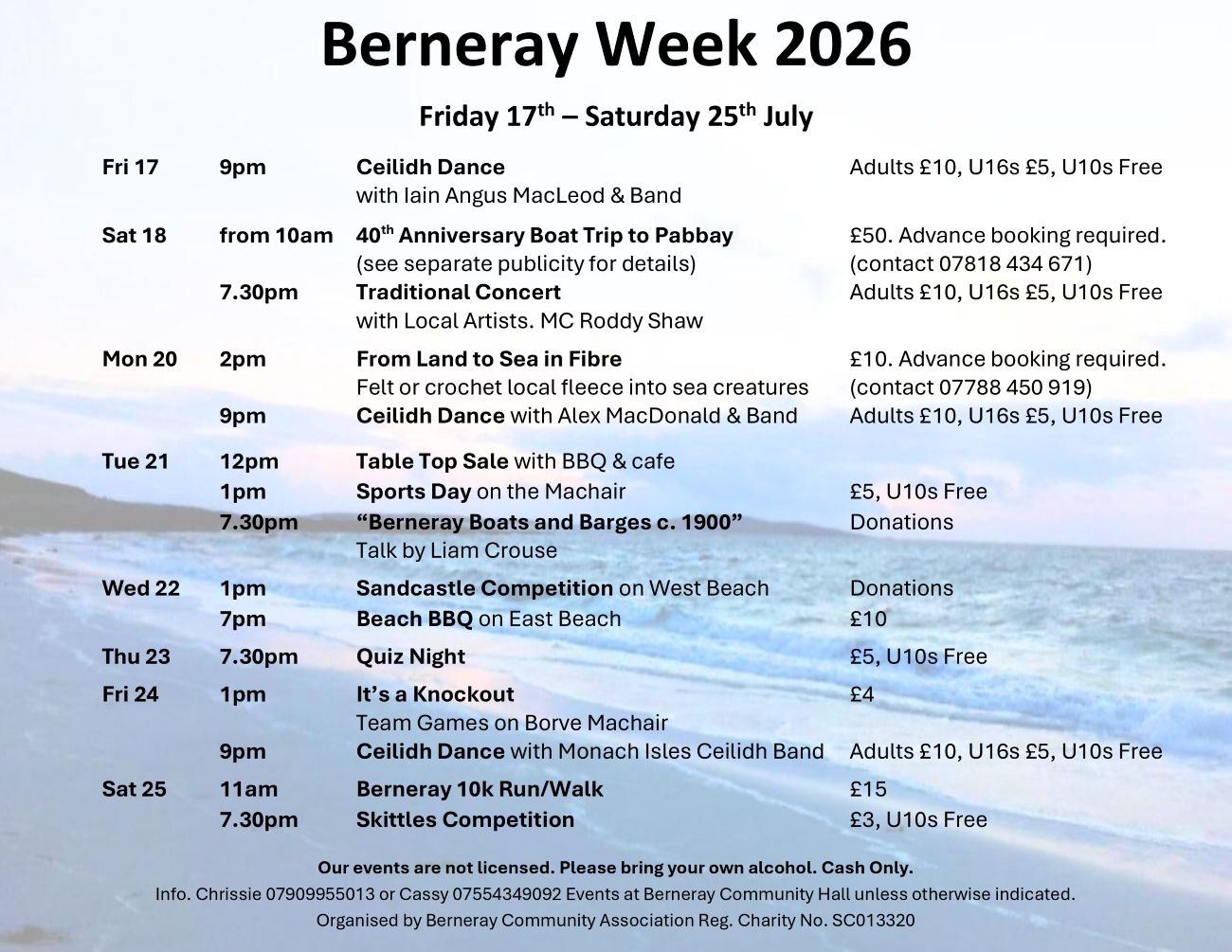
 - Berneray Week 2026
 Friday 17th – Saturday 25th July Berneray Week is back… Read more: Berneray Week 2026
 - New support for Community Gaelic Plans
 English below \\ Tha Bòrd na Gàidhlig air £60,000 a… Read more: New support for Community Gaelic Plans
 - Four young actors sought to tour original new Gaelic play at Blas Festival
 English below \\ Tha Fèisean nan Gàidheal air leth toilichte… Read more: Four young actors sought to tour original new Gaelic play at Blas Festival