Local businesses call time on ferry failures
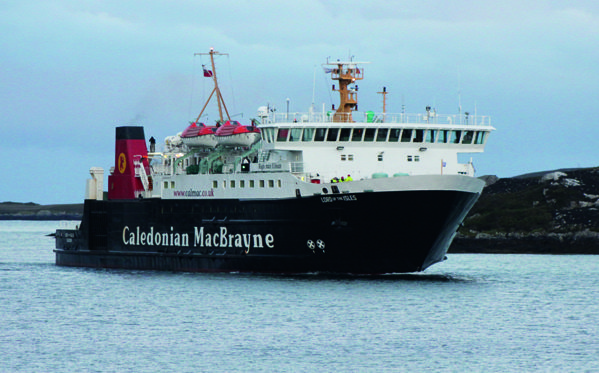
The issue of our failing ferries was brought to a head in May, when Uist was left without any lifeline service, with both The Lord of the Isles and The Hebrides out of action for emergency repairs.
The situation lasted for several days, leaving vulnerable supplies stranded in Uig, and throwing travel plans into chaos for tourists and locals alike.
The cost of that disruption was on the agenda for a new group established by local businesses, and facilitated by Storas Uibhist.
The Group held their first meeting on Thursday, 26 May, with representatives from tourism and food businesses, retail, aquaculture and shellfish. The group will now be reaching out to the wider business community with the aim of constituting a ‘formal, credible group that will speak with authority and with one voice’.
The Group is now preparing what they believe will be a set of reasonable and achievable demands, with practical solutions that can make things better in the ‘here and now’. These short term demands would include a set-in-stone contingency plan that could be relied upon to cover every service loss, an assurance that The Lord of The Isles is never taken off the Uist run to cover service losses elsewhere in the network, and a means of compensating businesses for financial losses incurred as a result of ferry failures.
All present at the meeting were clear that urgent action was required, as John Daniel Peteranna described: “This needs to be fixed now, our livelihoods depend upon it. If it’s not, the only option we face is to go back 200 years and start the highland clearances again.”
Christina and Kevin Morrison of Croft & Cuan have been instrumental in bringing the group together, driven by the knowledge that ‘data talks’. Christina explained: “We all get angry on facebook, it’s hard not to, but it doesn’t actually change anything. We know that we need the hard data to make Scottish Government and CalMac understand what the service disruptions mean to local businesses.”
Christina continued: “Our survey was just one small sample and included many small traders like ourselves. The full figure for the whole year and across the sectors will be shockingly high.”
The online survey asked whether ‘current reliability issues would lead to a reduction in services, a reduction in staffing or a closure of the business’ – 84 of the 130 responding confirmed that as ‘likely or very likely’.
Kevin describes how their own business has been hit: “When the summer timetable came out, we saw an opportunity. Our shop is right by the ferry and we knew that the passengers passing our door would generate good business. So we changed our opening hours and employed a new member of staff to meet the new demand, and it worked well for us. Those extra sales are now gone but the costs we have incurred to meet the opportunity are still with us. For us the loss has been keenly felt.”
These are big impacts for small businesses to carry; they have survived two years of lockdown only to face the highest inflation rate in 40 years. The continued threat to their livelihoods that the ferries pose is making the climb back to recovery steeper still.
Connie Pattillo, MOWI’s Area Manager, Uist & Barra explained that the impacts are not just felt in the the tourism and food sectors: “The disrupted ferry service has an impact on our farming activities; whether that be supply of important equipment or travel of contractors required to maintain our high standards of farming. We hope this group will clearly highlight the impact on the local economy and help to drive forward better connectivity and a reliable service to South Uist.”
Uisdean Robertson, Chair of the Comhairle’s Transport and Infrastructure Committee, has warned that short term solutions are not easy to find: “Things are going to get a lot worse before they get better, and be aware, we are a good three years from better.”
Alasdair Allan MSP told Am Pàipear: “Local businesses and individuals in Uist have experienced disproportionate and increasing levels of severe and prolonged disruption to ferry services from Lochboisdale and Lochmaddy over recent years. For example, Calmac’s own performance data shows a near 100% reduction in passenger numbers between 2018/2019 and 2022 for Lochboisdale, with four out of the past twelve months having an almost complete cancellation of service for one reason or another. This unreliability undermines islander and visitor confidence in our islands’ ferry services, as well as the immediate inconvenience and loss of income for many. I have been in regular correspondence with a number of Uist businesses about the ongoing issues and will be meeting with a group of local business representatives when I am next in Uist in June.
“It is my understanding that CalMac is in the process of reviewing the results of a feasibility study into chartering the MV Pentalina. Furthermore, the addition of the MV Loch Frisa this summer should help begin to rebuild the network’s resilience. However, to improve matters longer term, Harris and North Uist must have their own dedicated vessels, and the new Mallaig- Lochboisdale ferry, due in 2025, must dramatically increase the service’s reliability as well as overall capacity.”
A new email address has been set up to capture more data and everyone who had experienced the impacts of ferry service failures, whether a business operator or a member of the public, is being encouraged to email ferryimpact@storasuibhist.com.