
New report highlights inequality for island shoppers
Tagsa Uibhist has published a new report calling for ‘immediate and progressive action by national and regional authorities to address the difficulties of food insecurity in Uist and Barra’.
The Our Right to Food Report sets out the findings of a study Tagsa carried out earlier this year in partnership with Nourish Scotland looking at the affordability and accessibility of basic fruit and vegetable items in Uist and Barra.
The research findings evidence that people living in the Southern Isles are disproportionately more disadvantaged in terms of affording and gaining access to basic fruit and vegetables.
Alex Mackenzie, Tagsa Uibhist’s Local Food Development Manager, explained how the study was carried out:
“Our Community Researchers set out to find a mixture of fruits and vegetables from an example weekly shopping list for a family of five. The list comprised of 17 basic fruit and vegetable items including fresh produce, frozen goods and pantry items, providing the basis for a ‘right to food’ metric in terms of the affordability of a healthy diet.
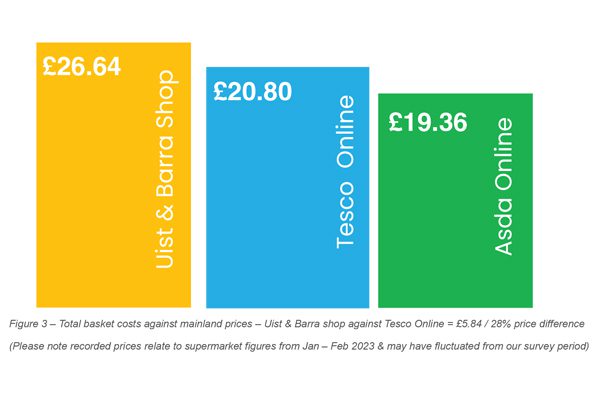
“Less than half of the shopping list items were easily accessible and furthermore the total basket cost was 28% more expensive than a Tesco Online shop.”
The Report shows that: “Rather than paying £1.10 for a 1kg bag of mixed vegetables (Tesco Online) Islanders were on average paying £2.87 and sometimes paying out £4.67 for frozen mixed vegetables. This same trend was found against other food items with pasta sauce equating to 233% more than a Tesco equivalent; paying £2.83 for a 500g jar of pasta sauce compared with £0.85 for a Tesco product.”
Alex says that the Uist findings were in stark contrast to other rural mainland communities and evidenced worrying trends on the dietary inequalities for island communities.
The Report provides interesting detail on how the Co-Op classifies its island shops by size and revenue – convenience store, supermarket or superstore. Of the four Co-Op shops within the survey area, two are classified as ‘convenience stores’ and as a result, shelf space is prioritised for branded, convenience food such as pizza and ice cream, with less space allocated to fresh, own-branded or value range produce.
“Larger retailers need to recognise that a convenience store classification which gives a heavier weighting to convenience foods and top branded goods is not serving our island communities well.
“All our Island shop staff are trying to ease the burden of the cost of living crisis but in some cases are restricted to centralised ordering and buying systems which don’t make any concessions for Island life.”
In terms of availability of faired better, with autonomy over their ordering requirements and the ability to stock local produce: “Co-op stores need agreement from headquarters to stock local produce and there would be a requirement for the local producer to be operating at a sufficient scale to provide their produce throughout all the Co-op Scottish stores which acts as a deterrent for small scale local producers.”
Our Right to Food follows the publication earlier this year of Tagsa’s Small is Beautiful Report, which set out the opportunities for growing Uist’s sustainable food options.This latest study continues that theme, saying:
“There is huge potential to increase the amount of local food available to the local community and provide horticultural training to encourage people to grow locally.”
The Report concludes with a clear call to action:
“There is a strong call by our community researchers for immediate and progressive action by national and regional authorities to address the difficulties of food insecurity in Uist and Barra. Food supply chains are broken, and our findings show that the health of islanders is compromised by limited access to adequate, nutritious, and affordable food, particularly during the winter months.”
Our Right to Food


Latest News
- CMAL secures ownership of remaining Cemre vessels to protect delivery for island communities
 Caledonian Maritime Assets Limited (CMAL) has taken ownership of the three… Read more: CMAL secures ownership of remaining Cemre vessels to protect delivery for island communities
 - Island dancers set for North Carolina
 This July, two young dancers from the Outer Hebrides are… Read more: Island dancers set for North Carolina
 - Berneray Week 2026
 Friday 17th – Saturday 25th July Berneray Week is back… Read more: Berneray Week 2026
 - New support for Community Gaelic Plans
 English below \\ Tha Bòrd na Gàidhlig air £60,000 a… Read more: New support for Community Gaelic Plans
 - Four young actors sought to tour original new Gaelic play at Blas Festival
 English below \\ Tha Fèisean nan Gàidheal air leth toilichte… Read more: Four young actors sought to tour original new Gaelic play at Blas Festival