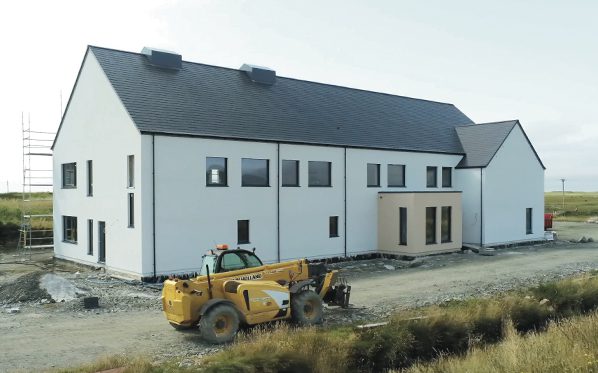
Passivhaus standard achieved at new centre under construction on South Uist
Iain Stephen Morrison
Cnoc Soilleir achieved a critical milestone in its construction when it met the Passivhaus standard after tests were conducted at the end of August.
Passivhaus refers to a building that meets certain standards of airtightness and passive heat gain, with a view to minimising energy consumption. More than 65,000 buildings have now been designed, built and tested to this standard across the world, with Cnoc Soilleir the first in the Western Isles.
Last month the entrances on the now well advanced Cnoc Soilleir were sealed before the air pressure was dropped and then raised. Passivhaus buildings must achieve an airtightness level of less than 0.5 and, at the end of the assessment, 0.4 was recorded for Cnoc Soilleir.
“Contractors spent a lot of time making sure the construction is really tight,” explained project manager Catherine Yeatman.
“It was an anxious moment as the assessor went around with a smoke pen, checking all the areas where leaks would be expected, but a great result to achieve 0.4 at the end of the test. It is important to hit this level before plasterboard covers up the base structure, as we could see where there were leaks and seal them as required.”
Passivhaus buildings are designed to have low energy requirements for space heating and still be comfortable for occupants.
“It is about fabric first and making the building as energy efficient as possible,” continued Catherine.
“Passivhaus means the design and construction processes are robust in terms of making sure those corners and awkward areas where heat could be lost are as thermally efficient as the rest of the building.
“It is also about building orientation and Cnoc Soilleir has been constructed to maximise solar gain in the winter and restrict it in the summer.
“Passivhaus also means a stable thermal environment inside as the building will react slowly to temperature changes outside. It will always be the same temperature inside. Because of the orientation of the building and the large windows, the use of electric lighting will be minimised.
“However, the other benefit is fresh air, which is heated through a heat exchanger. Each room has its own supply of fresh heated air so windows do not need to be opened to lose heat from the building.”
Each room fitted with its own fresh air supply will be even further beneficial, with Cnoc Soilleir set to open in a world still coming to terms with the prevalence of COVID-19.
“Because this building is an educational one and will be used for teaching the ventilation rates were already quite high. But here you are not sharing air with other people as the air is not being circulated through the full building. Each room and each place is a fresh air bubble, which we now know is important. It is an additional benefit in terms of COVID-19 and, while that was not the reason that we went for the Passivhaus standard, it is a bonus.”
Cnoc Soilleir is to be a state-of-the-art institution for education, music, dance, culture and Gaelic and is being developed through a partnership between Lews Castle College and Ceòlas. Lews Castle College will deliver courses from the centre during the week in term time, while outwith core college hours Cnoc Soilleir will become the base for events and activities with Ceòlas.
Cnoc Soilleir includes classrooms and teaching spaces for students with both Lews Castle College and Ceòlas. Plans for the centre also include a resource centre, recording studio and offices for both Lews Castle College and Ceòlas.
It is envisaged the new centre will enable further growth in the Gaelic language economy in an area that is recognised as a key community for the revitalisation of the language in Scotland.
Local contractors, MacInnes Bros Ltd, started work on construction of the first phase of the new centre early in 2020 and it is anticipated this will be complete in the spring of 2022. Phase one will see the construction of teaching and office spaces, while the second stage will comprise a bespoke auditorium and dance facilities. It is estimated the second phase will cost around £5 million to develop, with £3 million secured earlier this year from the Scottish Government.
Cnoc Soilleir has received funding from numerous individual donors, Scottish Government, Highlands and Islands Enterprise, Comhairle nan Eilean Siar and Bòrd na Gàidhlig.