An in depth look at one of our most controversial issues
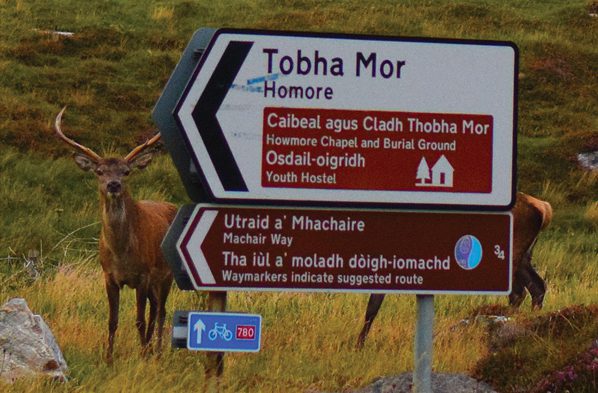
Deer: there are few issues that divide the Uist community more. Feelings run high, views are polarised and conclusions are hard to reach.
On one hand, there are those who believe this undeniably beautiful creature has a crucial role to play in our fragile economy; on the other, are those who oppose the deer’s presence on the islands, citing our alarmingly high incidence of Lyme Disease and the damage marauding deer cause to crofts and gardens as more than outweighing any financial gain.
In the last weeks, there have been moves to break the deadlock and instigate change.
Bornish Community Council is running a survey to better understand the views of those living in the 11 townships between Drimsdale and Frobost. A spokesperson for the Community Council said they “wished to find out if the types of complaints and comments made to them are representative of a wider community view, or not.”
In a separate move, local resident Ronnie MacKenzie has instigated a petition proposing that South Uist community landlord Sealladh na Beinne Mòire remove all deer from the estate area. At the time of going to print, it was not clear if the motion had not gained the 10% of membership support required to force an Extraordinary General Meeting (EGM) to debate the motion.
Over the following pages, Am Pàipear attempts to separate the fact from the fiction, and to set out the key issues that will allow readers to make up their own minds on deer. We do not claim to have covered every detail, and recognise this article is not exhaustive.
This article has been informed by Glasgow University, NatureScot, NHS Western Isles and members of our own community. Many of the people we spoke to asked to remain anonymous; their quotes are included here but their names have been withheld.
Deer in Uist
Red deer are the only species of deer found in Uist. They were introduced to North Uist in Neolithic times, and to South Uist in the 1970s by the then owners of the estate.
How many deer do we have?
North Uist Estate carried out a helicopter count in 2018, which confirmed the herd at 945 animals, and a foot count in 2019, which concluded the figure had dropped to 779. The Estate says it aims to manage the herd at 700 animals, with a 50/50 split between stags and hinds. A further foot count is planned for 2023.
Storas Uibhist carried out an independent helicopter count in September covering every area of the Estate. The count concluded there were 316 stags, 684 hinds and 198 calves. The numbers were well above the agreed stocking target of 200 stags and 200 hinds, and Storas Uibhist confirmed its commitment to cull back to target, and pursue a policy of aggressive removal of problem stags from low ground in the west.
Across Uist, stocking densities are lower than the maximum 10 deer per sq/km guidelines suggest as best practice, but the geography of the island can mean the animals are present in villages and agricultural land where stocking levels cease to have much value as a means of determining impact. It is this move from the hills of the east to the inhabited west side that has caused much of the growing friction.
Whose deer are they?
In Scotland, wild deer are considered to be ‘ferae naturae’, the traditional Latin phrase for animals which are wild by their nature and classified in Scots property law as ‘res nullius’. This means that a wild deer is owned by no-one until it is rendered into possession by being killed or captured.
Hunting rights belong to the owners of the land, the estates, but in Scots property law, the authority to shoot deer without the permission of the land owner is extended to occupiers of the land, for example crofters.
The Deer Scotland Act 1996 (as amended) gives occupiers of agricultural land or enclosed woodland the statutory right to take or kill deer to protect their crops and related interests from damage, independent of the views of the owner of that land. Occupiers also have the right to sell the deer they have killed, or otherwise dispose of it.
NatureScot also issues a General Authorisation to allow the shooting of deer in certain circumstances to prevent damage to crops, pasture or human or animal foodstuffs. The General Authorisation is published on the NatureScot website and although occupiers do not have to apply, they must satisfy themselves that they are complying with the requirements, otherwise they could be committing an offence.
The owners of garden areas around dwelling houses have sole responsibility for undertaking protection from deer, but do not have the right to shoot them.
The Comhairle has deemed lethal control is not permissible on their land unless for public safety or deer welfare, for example if a deer is trapped or entangled.
How are deer managed?
The management of wild deer ultimately sits with Scottish Government, but is overseen by NatureScot and devolved to voluntary local Deer Management Groups (DMGs), set up to foster a collaborative approach and to take account of varied interests. The groups operate under a nationally agreed Code of Practice.
A spokesperson for the Uist Group said: “The Uist Deer Management Group (UDMG) was formed to bring all the relevant stakeholders around the table to discuss the future for sustainable management of the red deer herds on North and South Uist, and as a forum to raise concerns and resolve issues from local communities such as marauding deer on crofts, deer in public spaces and gardens, deer vehicle collisions, poaching incidents and the prevalence of Lyme disease.”
The Uist DMG published its draft Deer Management Plan in 2017 but says “the document has not been ratified/adopted as yet as meetings were cancelled due to COVID and logistical problems.” The Group also published a draft High Priority Control Area strategy, but this too has yet to be agreed.
The Group also said “bi-annual meetings are by invitation only, but due to covid the meetings have not been held for three years.”
Many of the people we spoke to expressed the view that the Uist DMG was not currently fit for purpose, citing the infrequency of meetings, the lack of any substantial progress in agreeing management plans and most notably, the hostile and non-inclusive way in which the Group operates.
The Group’s Chair resigned in September.
Economic value
The economic value of deer is not in question. Their presence brings tourists, and tourism brings income. It is more difficult to tease out the tourism value attributable solely to deer, and not to fishing or wild fowling, which both generate substantial revenues for the estates.
“Wild deer are a huge asset to Scotland as: an important part in our rural economy and culture; an integral part of Scotland’s biodiversity; and a source of healthy food and recreational opportunities.”
NatureScot, Scotland’s deer authority
“The stalking activities of North Uist Estate play an important role as the income generated assists with the associated costs for the overall management of the Estate. The red deer herd is managed in a sustained fashion in order to preserve its value and importance to the Estate. Consequently, this in turn both directly and indirectly, supports other local businesses that rely on those who participate in this activity. It extends the season for hoteliers at some quieter parts of their season, as well as other businesses and outlets which offer local produce, gifts, artefacts, etc. It is impossible to quantify the exact tourism value, but it must be substantial. However, anecdotally a glimpse of a red deer alongside an otter or an eagle is the highlight for many a visitor to the islands.
“Clients come from the UK mainland and from overseas to participate in stalking activities, as well as local residents. We have many clients who return each year and take trophy beasts, which are then prepared for them by a taxidermist for onward travel to their destination. A trophy beast incurs an additional fee which in turn adds to the income for the Estate. The fee generated from the taxidermist also brings income to yet another business.”
Christine Macleod, Factor, North Uist Estate
“We believe a well-managed, healthy deer herd is an asset for the Estate. The only alternative to this is to have no deer at all, and we do not believe that would be advantageous to the community. Storas Uibhist believes that the benefits deer bring outweigh any negatives.”
“Deer bring a direct economic benefit to South Uist in terms of income from stalking, which last year was around £25k pa, and venison sales, which bring in a further £15k-£20k pa. Many of these stalking guests also stay at Grogarry Lodge, bringing in further revenue for the estate. There is also considerable knock-on value through wider tourism spend. And then there are the people we are able to employ as a result of all this, and the value their wages add to the local economy through shops and services.”
Darren Taylor, CEO, Storas Uibhist
SnBM accounts will be available to the public at the forthcoming AGM.
Deer as food
Venison is a good source of income for the estates and has the potential to be a healthy, sustainable, and locally sourced protein for Uist residents.
“The Estate sells venison for domestic use and to several other outlets at peak times of the year. The meat is of a high standard, very affordable and no saveable meat is wasted. Venison is one of the most sustainable red meats to be found in the UK, with a low-fat content making it amongst the healthiest.”
Christine Macleod, Factor, North Uist Estate
“`Deer do have a detrimental impact on those trying to grown their own food locally. Experts are warning that we may be facing food shortages this year, yet for the first time in 20 years, my family will not be able to grow any of our own vegetables because of raiding deer.”
Uist resident
Environmental impacts
The environmental impact of deer sits under three broad headings – nature, crofts and gardens; in terms of all three, the damage that deer cause has been widely recognised and reported.
The natural environment
The Government’s new Draft Biodiversity Strategy sets a clear target to reduce deer numbers in Scotland.
“Whilst sustainable and effective deer management has long been recognised as a vital contributor to land management, twin biodiversity and climate crises mean our actions to mitigate and prevent damage by deer on our environment are now more important than ever.
“Herbivores such as deer cause damage by overgrazing and trampling vulnerable habitats and preventing young trees from growing. It is vital we protect tree-planting, woodland regeneration and peatland restoration from further damage if we are to meet our climate change and biodiversity commitments and protect our environment.”
Scottish Government
Crofts
Croft damage by deer covers a wide range of impacts, from grass lost to rogue grazing to trampled, decimated crops and ruined silage. Crofters also carry the burden of additional treatments for tick borne diseases such as Louping Ill.
“The most common types of damage by deer to agricultural crops are to early season grass and cereals. Wild deer can also act as a constraint on options, for example, not growing root crops in some areas due to the high risk of damage……In addition to direct physical damage by deer, there are also concerns over the health of livestock due to contact with deer and the risk of the transmission of diseases.”
Deer Working Group, Scottish Government
“If it was cows causing this damage, we’d be asking who they belonged to and checking their ear tags to ensure somebody took responsibility. With the deer, we can’t do that. They are nobody’s concern but the poor crofter whose crop is being trampled.”
Crofter, Uist
Gardens
Much of the negativity towards deer is as a result of the damage they cause to gardens, and the heartache and costs this incurs. Am Pàipear heard of many cases where deer were persistent visitors to gardens, trampling plants and actively targeting trees and shrubs.
“I’ve reported the deer in the garden umpteen times but by the time the Estate workers arrive, the deer have gone and the damage has already been done.”
Uist resident
When the question of deer protection was raised, many people responded negatively, referencing both the cost of high, deer-proof fencing and the visual impact it causes.
“This feels like living in a prison. It is us who are caged in behind high fences whilst the deer roam free.”
Uist resident
Gardens were impacted across the islands, both north and south, but clear hotspots were identified in the middle district and in the villages on the east side of the main road. One resident we spoke to in North Uist described the sadness and frustration she felt at seeing 20 years worth of planting destroyed by persistent deer incursions.
Both crofters and gardeners referenced the recent change in deer behaviour, with deer entering safe spaces they would previously have been too cautious to approach, and stags being unafraid of humans and standing their ground when attempts were made to scare them away.
Deer and road traffic accidents
People raised the issue of deer on the road, and anecdotally, numbers do appear to have risen. Westside Motors, which delivers bodyworks services on Uist, told Am Pàipear that cars requiring work as a result of deer collisions were a frequent occurrence, with but that numbers had fallen substantially this year. Whether this is because of fewer deer on the road as a result of active management, or whether drivers are simply more aware of the risk is unclear.
Because deer are not ‘owned’, insurance claims can not be made against any one party, which may mean some deer collisions go unreported.
“It’s estimated that collisions between deer and vehicles could be as high as 9,000 per year in Scotland, resulting in 50 to 100 human injuries. The majority of collisions take place in early evening through to midnight, with another peak occurring from 6am to 9am. Over the past 50 years, the number of wild deer in Scotland has increased, as has their range. In the same period, the volume of road traffic has almost doubled.”
NatureScot
Deer, ticks and disease
The role deer play in relation to ticks and Lyme Disease has been hotly contested and there have been misleading comments on all sides of the argument. While there is a lot scientists still don’t know, there is plenty on which they agree.
Lyme Disease in Uist
The Western Isles has the highest rate of Lyme Disease (LD) in the UK, and 80% of those cases are right here in Uist. Last year in Uist, NHS WI recorded 31 cases of LD identified by the classic Erythema Migrans bullseye rash, and a further 5 cases diagnosed by blood tests. Seen per capita, our case numbers make a shocking comparison to national figures. Simply put, you are more likely to get LD here than in any other part of the UK.
| Population | Cases | Cases/100,000 | |
| UK | 67,220,000 | 2,000 | 4 – 5 |
| Western Isles | 26,500 | 45 | 170 |
| Uist | 4,612 | 36 | 781 |
The majority of LD cases are quickly and successfully treated with antibiotics, but an estimated 10% of people suffer long term symptoms that negatively impact their quality of life, sometimes to devastating effect. In Uist, that 10% figure equates to between 3 or 4 people each year.
The role of deer
Lyme Disease is caused by the bacterium Borrelia, which in Uist, is most often carried by small mammals such as brown rats and field voles.
The borrelia infection reaches us via ticks, which pick up the borrelia from feeding on the blood of infected animals. Most borrelia infections are transferred by the tiny tick nymphs, which at less than 2mm in size, are difficult to spot and tend to stay longer on us before being noticed and removed.
The lifecycle of the tick is complex and impressive, involves multiple hosts, and lasts for several years. As the ticks move through their life stages – from egg to adult – they require more and more food, moving from the small mammals that originally infected them with borrelia, to the larger mammals that can sustain them with enough blood to reach sexual maturity and start the cycle all over again.
For breeding success, the adult female not only has to feed continually for 10 days, but to find a suitable breeding partner on the same host. Fed and fertilised females will then drop off their host and lay around 2000 eggs.
The tick’s success relies on finding an animal that is untreated with insecticide (so not, for the most part, livestock), is mobile (to allow them access to new ground) and crucially, is unable to remove it from its skin (so not humans or pets). Thus their favourite food is deer.
There are two distinct but related life cycles at play. Firstly, our unusually high number of field voles and brown rats are playing a key role in infecting ticks with the pathogen that causes LD. This marks us out as separate from other islands and allows the borrelia pathogen to flourish here.
Secondly, we have an abundance of deer which act as both transport and breeding ground for ticks, and in turn, allows the ticks to flourish here.
The deer aren’t giving us Lyme Disease, the ticks are; but without the deer, the ticks would not be present in such high numbers, and our rate of infection would not be so high. If the national average infection rate was applied to Uist, we would not have any cases at all.
Fact and fiction
Am Pàipear asked Drs Roman Biek and Jonathon Yardley of Glasgow University, who are leading the latest tick research in Uist, to sense check some of the statements that are made in reference to deer, ticks and Lyme:
“There is no proof that deer cause Lyme Disease”
Independent from our own work, there is ample evidence from North America and Europe that deer play a major role in maintaining the tick populations that are necessary for the tick-pathogen transmission cycle. That doesn’t mean that other hosts (such as livestock) couldn’t contribute as well in some places but to say that deer have nothing to do with Lyme disease (or the risk/hazard of getting it) is not supported by the evidence.
“If it is deer, then how come there are so few cases in the rest of the Western Isles”
From initial results of the study, we know that most infected ticks on the Uists have Lyme Disease bacteria types that are associated with small mammals. The Uists have a more diverse small mammal community (including field voles and rats) than Barra and Harris (where field voles are absent for example). However, deer are likely increasing tick abundance in the Uists therefore you are more likely to have a higher density of ticks that can be infected. We in fact have not found any ticks on Barra and Harris thus far which have the type of Borrelia that small mammals are associated with, whilst 97% of the infected ticks in Uists that we have collected do.
“The deer samples returned to the lab show very little sign of Lyme Disease”
This is irrelevant – deer don’t carry the Lyme disease bacteria, they cannot maintain it and ticks do not pick it up from them. But this doesn’t mean that deer don’t play a major role in maintaining tick populations.
“If the deer were removed we would still have the same problem as sheep, dogs or humans would sustain the ticks”
Dogs and humans are not able to sustain tick populations – the number of adult ticks found on dogs is not large enough, therefore they wouldn’t have a chance to breed. Humans are completely irrelevant – they rarely get adult ticks on them and if they do, the tick is unlikely to go unnoticed and therefore, to find an adult male to breed.
“If deer were removed from Uist entirely, we’d see the end of the ticks”
If deer are removed from an island, we would expect to see a dramatic reduction in tick numbers after about 3 years, but other hosts such as livestock might still be able to support tick populations. This is seen in our data – in addition to South Harris, Barra is also essentially free of deer but still has ticks present. The same is true for many other islands around Western Scotland, which have no deer but still have ticks.
The Glasgow University research team will be presenting the results of their work so far at a public meeting in Balivanich Hall on 9th November