By Danny Rafferty
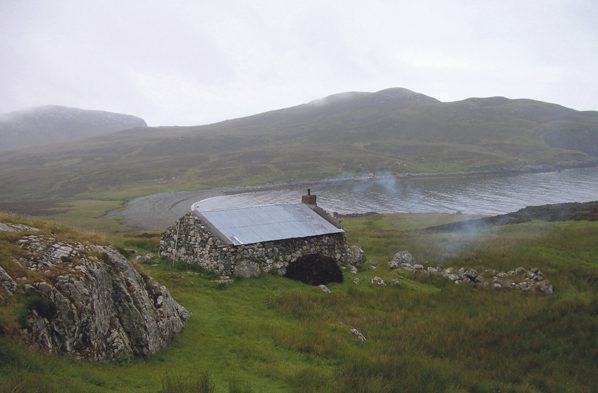
Uisinis Bothy is on the south side of Mol a Deas, which is a boulder beach about two miles south-west of Uisinis Lighthouse. It was first renovated by the Mountain Bothies Association (MBA) volunteers in 1979 in memory of Donald H Stuart, a staunch contributor to early MBA work parties, and it offers basic accommodation and shelter to walkers and those interested in the outdoors. It is the only MBA-maintained bothy in the Outer Hebrides.
The MBA was founded in 1965 and the first projects were in the Borders of Scotland and the north of England. The MBA works in partnership with estate owners and today maintains over 100 bothies with the majority in rural and upland Scotland. With the agreement of the estate owners the MBA renovates traditional vernacular buildings in remote locations and renders them habitable. In the majority of cases it does not actually own the bothies. This work is done by volunteers, as is everything else in the MBA except for some outsourcing for the purposes of audit and membership affairs. On its fiftieth anniversary in 2015 it received the Queen’s Award for Voluntary Service.
The MBA is a membership organisation and is financed by subscriptions and the occasional legacy. You do not have to be a member to use bothies and there is no charge. You are, however, expected to follow common-sense rules and respect the building, the environment and your fellow-users. In short, leave the place in as good or better condition than you found it. All bothies have a bothy book and the number of entries helps us to monitor levels of use. Many interesting anecdotes are recorded and some people are inspired to create poetry and pictures. An increasing number of visitors are from abroad.
Uisinis is a small two-roomed building facing east-west about 50 metres above the shore. The first room is a storeroom for tools and some fuel. Part of the floor here is earthen. The living-space has two wide bunkbeds and a single bench which also can also serve as a bed. It has a stove which can burn dry peat, coal or driftwood but not plastic. Water is obtained from a burn 200 metres to the south, but there must have been a closer source when the building was continuously occupied. The bothy can accommodate about six persons in reasonable comfort.
Today the east side of South Uist is uninhabited and seems remote. Its rugged character is very different to the flat fertile lands of the west. However in the past it did have advantages as a place of settlement: it was more sheltered from the prevailing south-westerlies; it had all-season access to the Minch at a time when fishing was far more productive; it had a plentiful supply of seaweed for fertiliser and kelp, peat for fuel, and possibly a slightly milder climate. Like Knoydart across the Minch it was a good place for wintering cattle. Testimony to the former sizeable population can be seen in the landscape with the numerous feannagan – lazybeds – in evidence. However sheep husbandry was introduced after the change in estate ownership in 1838 and the catastrophe of the 1846 Potato Famine. The existing population was removed and a lesser number of shepherds and their families mainly from the Bracadale area of Skye introduced to the area.
The building we see today probably dates from the 1860s and was continuously occupied at least until the early 1920s when the famous Scottish naturalist Seton-Gordon happened upon it when he was lost in mist. He was well received by the resident family and this is recorded in his ‘Hebridean Memories’ – still in print.
When the MBA took on the building in 1978, Uisinis was still being used by crofters seasonally for gatherings. In fact there was always guidance for recreational users that priority should be given to them. The crofters would visit the lighthouse staff in the evening. The keepers were able to receive television beamed from Skye before it arrived in Uist and the visitors could then describe the programmes and relate storylines to friends and relatives at home. The lighthouse became automatic in the early 1970s.
There was an MBA work-party at Uisinis in 1998 and the building was transformed by four work-parties between 2011 and 2015. In 2014 the old roof was removed and a new one put in its place. That took a small team of volunteers a full month to execute and was a Herculean task. Stòras Uibhist has always been supportive with transport and assistance.
Not only is Uisinis a beautiful place to visit it also is rich in archaeological remains particularly Iron Age wheelhouses and souterrains. If you intend to visit with a party of four or more, you should inform the estate and myself. During the stag-shooting season which runs from about the beginning of September to the end of October users should inform the estate on 01878700101 of their intended movements.
Given the weather in these islands there are always maintenance issues. If you would like to join me in caring for the bothy, I can be reached by email on d.rafferty18@btinternet.com. My landline is 01878700249 (voicemail). You don’t have to have DIY skills though that of course would be useful, just some enthusiasm and a willingness to help. If you wish to learn more about the Mountain Bothies Association, there is an excellent website.
Danny Rafferty, MBA Maintenance Organiser, Uisinis.