Autumn Jewels
Living on an almost treeless island on the edge of the North Atlantic, it is difficult to reconcile a typical Hebridean autumn with the season of “mists and mellow fruitfulness” eulogised on the mainland. Sadly, the sensory delights of a profusion of large, richly coloured fungi emerging from the mulch of fallen leaves in mature deciduous woodland or ancient pine woods, with their distinctive rich earthy smell, eludes us. Small numbers of woodland species can be found in the relatively recent plantations at North Loch Eynort and amongst the conifers at Langass and Cladach Vallay, but as yet, they are not as diverse or abundant as those found in the mature woods around Lews Castle.
Our landscapes may not be graced with ancient woodlands, but our grasslands are just as important and support an important community of fungi. Easiest to find are the dung fungi (mottlegills, inkcaps and roundheads), which play an important part in recycling the nutrients from animal manure. More elusive are the corals or club fungi, the short, yellow or mauve spindles or clubs, nestling down in the grass; or the pinkgills which are often pale brown, grey or even blue, named for their pink spores. Then, just as the wildflowers are fading, the autumn jewels of the grasslands appear – the waxcaps.
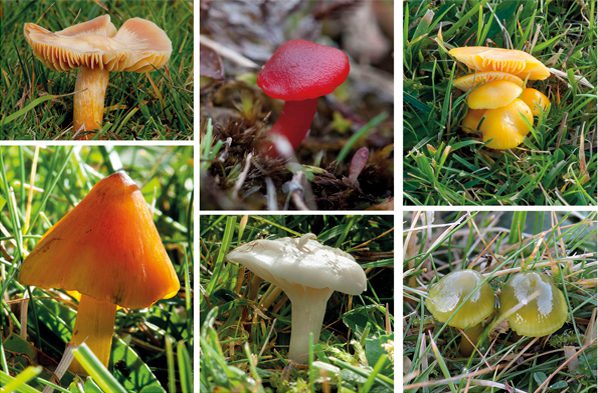
Like most groups of fungi, they can be variable in both size and colour. Small and delicate, stocky and robust, in a kaleidoscope of colours – scarlet or crimson, orange or peach, buttercup yellow, pale green, soft grey or a delicate ivory. The cap can be smooth and dry, slightly rough or a little sticky and sometimes slimy and glutinous. Some species can also have a distinctive smell, for example the cedarwood waxcap is reminiscent of old-fashioned wooden pencils.
Waxcaps can be enigmatic, typically found in unimproved permanent pastures, although they can also be found on lawns or amenity grassland in parks. We know very little about their ecology, but they prefer sites which have not been disturbed or enriched by fertilisers or heavy grazing. In common with woodland fungi, they may have a close relationship with plants, exchanging nutrients with the plant roots.
Their common name is derived from the waxy nature of their gills and not the texture of the cap. The fungus you see above ground is the fruiting body which produces the spores. In the familiar mushroom or toadstool type, the spores are usually produced from the pleated structures below the cap which are known as gills. The main body of the fungus consists of a network of slender threads (hyphae), growing in the soil, or through rotting timber, dung or other organic matter. Fungi have a complex biology and although we know comparatively little about their ecology, we are beginning to understand that they have a major role in maintaining our natural environment. Fortunately, we can still admire them, even if they are difficult to identify and have very complex lifestyles.
You can see more photographs of waxcaps and other fungi on the Outer Hebrides Fungi website (www.outerhebridesfungi.co.uk/index.php) and copies of the OHBR Grassland Fungi leaflet are available in museums and libraries and can be downloaded from the OHBR website
(www.ohbr.org.uk/wildlife-leaflets.php).
Photographs
Chris & Christine Johnson