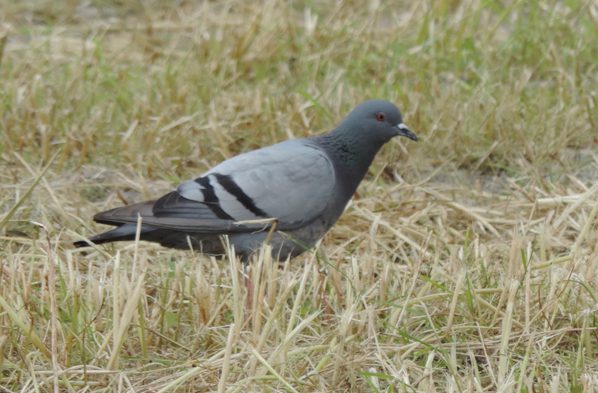
The Hebridean Rock Dove
Most of us see a pigeon every day without really noticing it. Since the dawn of human civilization, these birds have followed us around the world.
We first domesticated them to eat, but they soon proved their worth as messengers and sources of entertainment. The crazy feathers of fancy pigeons at exhibitions and shows helped inspire Darwin’s theory of evolution. On the other hand, being so popular has had some unplanned outcomes. All over the world, for the past few hundred years, some of these domestic pigeons have been escaping their cozy lives in captivity and becoming wild. Uniquely adapted to living alongside us, these ‘feral pigeons’ bred and now number in their millions, and can be found in almost every city and town in the world. Feral pigeons are often condemned as pests, making a mess of pretty streets and statues in famous squares all over the world. More positively, for many people, they’re one of very few connections to nature amidst the urban sprawl.
Whilst this global takeover was happening, the original wild pigeon, more technically called the Rock Dove, was doing what it’s always done, nesting in caves and cliffs, and foraging for seeds in meadows. Rock Doves are much shier than feral pigeons and are only found in places like the Outer Hebrides which are far away from their relatives’ urban strongholds. Unlike feral pigeons, who can have black, grey, rusty brown or white plumage, all Rock Doves look identical, with a blue-grey colour, a white patch on their back, and black bars on their wings. Unfortunately for them, their feral cousin has done so well that it has begun to infiltrate the Rock Doves’ habitat. Rather than simply outcompeting their rarer relatives, feral pigeons begin to interbreed with them. Eventually, particularly when feral pigeons outnumber them, Rock Dove populations are replaced with populations of hybrids and feral pigeons.
Whilst Rock Doves used to be found across the entire Mediterranean and Western European coast, they now hang on only in small relict populations. The Outer Hebrides, with its unique agricultural traditions and machair meadows, holds one such population. The rocky coasts of the east and the open lands of the west provide an excellent refuge for Rock Doves. Recent studies of their DNA have proven that they are, for now, essentially free of any contact with domestic or feral pigeons. Of the locations which were included in the study, nowhere else in the UK or Ireland had such a status.
The wild Rock Doves of the Outer Hebrides are one of the least understood birds in the UK. They have usually fallen beneath notice of scientists and birdwatchers, meaning that even basic aspects of their behaviour are not recorded. As long as the Outer Hebrides, and particularly their strongholds in Uist, remain free of colonies of feral and free-flying domestic pigeons, the Rock Dove will survive. So next time you see a pigeon fly by, take a moment to remember this is one of the very few places left in Europe where it’s hasn’t originated from escaped captive birds, but is the original, truly wild, version.
Will Smith