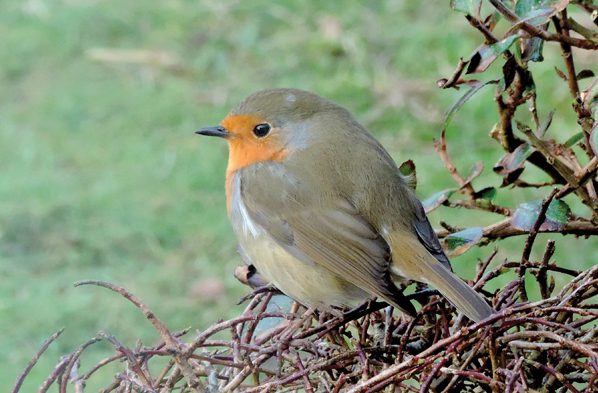
The Robin
The Robin we are told is associated with Christmas because in Victorian times, when Christmas cards first became popular, postmen wore red waistcoats and were nicknamed ‘Robins’. It is certainly the most commonly seen bird on our Christmas cards. Of course part of its popularity may well be that they can become quite tame and against a cold, grey, possibly white winter day, the Robin stands out as a bright splash of colour. Yet this cheerful looking bird, acting as emblem of peace and goodwill, can be very aggressive when protecting its territory.
Looking at the Scottish Wildlife Trust website I see that the Robin’s association with Christmas is strong: In one tale, it is said that when Mary was giving birth to baby Jesus in the stable, she noticed that the fire they had lit to stay warm and comfortable was in danger of going out. Suddenly, a small brown bird appeared and started flapping its wings in front of the fire, causing it to roar back to life. However, as the bird flew around tending to the fire, a stray ember made its way towards the bird, scorching its breast bright red. Seeing this, Mary declared that the red breast was a sign of the bird’s kind heart, which would pass on to its descendants to wear proudly forevermore.
The Robin has another claim to fame, as it was the first bird to have a book that’s entirely about itself. Written by David Lack, (The Life of the Robin H E & G Witherby 1943) he suggests its popularity is due to the fact that it sings almost all year round. At the end of summer when all else has stopped singing, male and female robins separate. Each then holds its own territory and sings in its defence. As spring arrives it is interesting to watch the change in behaviour as the male and female slowly learn to accept each other. The male bird will help to strengthen their bond by feeding her, which also provides extra resources for laying a good clutch of eggs.
Looking through my notebooks I see that Robins were rare in Uist forty years or so ago. I remember the Stonechat being thought of as kind of Robin substitute; the males having a fine orange red breast. At that time Stonechats were one of the few small birds that stayed with us throughout the winter. Robins were confined to places that had some trees and shrubbery. For me living in Daliburgh that meant searching for them near the Doctor’s gardens in Lochboisdale and Daliburgh along with parts of South Lochboisdale where gardens provided the required shelter.
How things have changed. Warmer, wetter winters and the important addition of more gardens with trees and shrubs, substantial forestry plantations and the now quite frequent provision of wild bird food have altered species numbers and distribution. Robins are now commonly seen in our gardens throughout the year along with other small birds such as Goldfinches and Greenfinches.
The Robin in the attached photo I call Spot Robin because of the pale patch above its left eye. It is heading into its sixth winter, which is about as long as a robin is expected to live. The Robin and the Stonechat both like to sit up on perches; a spade left out in the garden as in this Christmas card by the wildlife artist Peter Partington or a fence post like that in the Stonechat photo.
Bill Neill