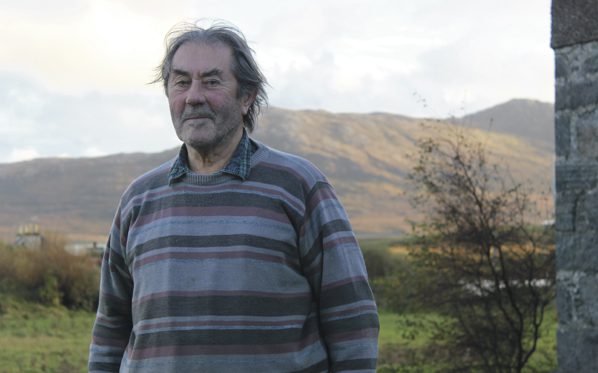
Norman Johnson looks back on an eventful life and varied career as he turns 90
Iain Stephen Morrison
Piper, dancer, soldier, police officer, district clerk, social worker, blaster, councillor and property developer…all hats worn at some time or another in the life of Norman Johnson. Could it be that a varied career and an aversion to retirement is the key to a long life and good health? Listening to him talk about his own story, Norman, who recently celebrated his 90th birthday and remains almost as active as ever, would appear to confirm the theory.
Born at Elsie Ingles Hospital in Edinburgh on 26th October 1931, Norman is the eldest child of Peter and Maggie Johnson. His father was a merchant seaman from Muckle Roe, Shetland, while his mother hailed from North Uist. Norman was raised in Leith with his brother, Donald, and sister, Rena.
“I was brought up in Leith but we used to go on holiday every summer to North Uist. We were on the island when the war started in 1939 and my father, who was at sea, sent a telegram to us suggesting we stayed where we were in Middlequarter. We lived in my grandfather’s house, which was empty, and, after the summer break, started attending Dunskellar School,” recalled Norman.
It was something of a culture shock swapping the family home on North Junction Street for Middlequarter, not least as the language of the community was Gaelic.
“We did not speak Gaelic at the time but everyone else did at school and the teachers spoke to us in Gaelic. I remember going to school this day and telling one of the boys that I was going to start talking in Gaelic. I started to speak Gaelic, for the first time ever, and another boy heard me, let the others know and they all started to laugh. It really affected me and I never spoke another word of Gaelic until I was 18.”
Like many families at the time, the war brought tragedy as Norman, then aged nine, lost his father when the ship he was sailing on, SS Abbotsford, was torpedoed and sank in the North Sea in March 1940. Later on, while the conflict still raged but looked to favour the Allies, Maggie Johnson and her three children returned to their home in Leith.
“I went back at my old school, Leith Academy, but this day a woman who lived above us came to speak with my mother and told her about a notice in a newspaper, advertising bursaries for boys who had lost their father to attend George Heriot’s School. I applied and was successful,” explained Norman.
It was there he started a lifelong association with the bagpipes.
“George Heriot’s School had a pipe band, with an instructor who had been in the Boer War. I joined the band, bought a chanter and book, and that was the beginning for me and the pipes.”
Norman left school in 1948 and took up his first job as a clerk with DT Russell and Baird, grain and flour importers based in Leith.
He was then called up for National Service at which time he joined and was appointed piper for The Black Watch. Norman was posted to Fort George to undergo infantry training for three months and, while there, the Highland Brigade, made up of all six Highland regiments, established their training centre for pipers and Highland dancers with eager participation from Norman. He was posted to the Queen’s Barracks, Perth in 1951.
When his National Service came to an end in 1952, Norman successfully applied to become a constable, piper and Highland dancer with Edinburgh City Police. During his years with the Edinburgh City Police Pipe Band they won the World Championship. He later transferred to the CID unit and remained with the police until 1962, at which time he had achieved the rank of Detective Constable.
It was during this time, while on the beat in the centre of Edinburgh, that Norman would encounter the woman that became his wife of 65 years and counting, Margaret.
“I was often on point duty in the middle of the city and one day at Shandwick Place this young woman on a bicycle, who looked nice, came along the road and I decided to make her stop. I didn’t speak to her and eventually waved her on. I was looking out for her the next day and again stopped her but never said a word. I was on patrol a few weeks later when I saw her coming towards me with a small dog on a lead. I decided to say something and, as she approached, turned and said “I wish you would take me for a walk some day!’.
“We started talking and I told her that the police pipe band was going to be doing a charity show for three weeks at the Usher Hall and that I could get her a complimentary ticket if she would like to go and see me on stage. I told her where she would find me on duty in a few days so that I could give her the ticket. I passed her the ticket, she came along to the show and met me at the back door afterwards. We took the bus together to where she lived and that was how we got to know each other,” recalled Norman.
Norman and Margaret married in 1956 and settled in their new home on Marchmont Road in Edinburgh. Eldest son Ewen was born in 1958 with Niall following soon after in 1959. However, feeling an irresistible desire to return to North Uist, the family relocated in 1962 when Norman was appointed North Uist District Council Clerk for Inverness County Council. Alasdair, Helen and Mairead, the youngest of Norman and Margaret’s five children, were born after they moved to North Uist.
He started to train as a social worker in 1971, enrolling as a mature student at Moray House College in Edinburgh. Norman took up the role of social worker for the newly formed Comhairle nan Eilean Siar but was granted early retirement at just 50 years old in 1982.
However, it was not to be a ‘retirement’ as most would imagine, with Norman settling into a new career as a rock driller and blaster, working for his brother, Donnie. He came home each day black from head to toe, his family recall, creating the occasional trail of oily footprints on the carpet of family home the Old Court House in Lochmaddy.
During his time as District Council Clerk for Inverness County Council, Norman had a hand in discussions that led to the formation of Comhairle nan Eilean Siar. He would later balance his work blasting rock with the role of councillor, serving two terms, over a decade, as an elected member of Comhairle nan Eilean Siar.
Norman would later embark on another venture, in the role of property developer, when he acquired the derelict Sponish House. Lord MacDonald of Sleat built the three-storey house for his factor in 1803. It fulfilled numerous purposes over the years, with the one time sporting lodge later converted into a seaweed processing facility for Alginate Industries. However, the property was destroyed in a fire in 1990 and remained a shell until Norman purchased it in 1998. He has toiled on the renovation of Sponish House in the years since, working with builders, and was even on the roof fixing tiles while in his 70s. Now four apartments have been created within Sponish House.
Piping remains a passion until this day and, up until two years ago, Norman was a fixture at annual memorial services at the local war memorials on Remembrance Sunday.
Now at the age of 90, a milestone marked with his wife, five children, nine grandchildren and extended family last month, Norman says he has no intention of slowing down too much.
“I feel good and can still move around and even play the pipes. I do not feel old. I am grateful for that and the fact myself and Margaret have five children and nine grandchildren who are all fit and well. I am not sitting beside the fire for too long, still back and forth to Sponish House and that keeps me going. I am fortunate, looking back at most of what has happened in my life, and now we are where we are,” concluded Norman.