Cllr Uisdean Robertson, Uibhist A Tuath
At last, we have some good news on ferry services to Uist!
After being the community most affected by the debacle of the Ferguson Marine ferry contract scandal it is hard to find the words for the relief and delight at the news that Government has stepped up to the mark and recognised that the original decision – which was made in the central belt with no regard to people in Uist and Harris – to continue a shared vessel operation on our routes across the Little Minch to Uig was plain wrong.
I do not criticise Government for seeking to secure valuable manufacturing jobs in Scotland or restoring pride in commercial shipbuilding on the Clyde. This was a laudable ambition. However, this should not have been the main motivation driving the specification of lifeline ferries to island communities.
Had we been asked, the clear and unequivocal opinion of people in Uist and Harris was that what represented innovation in 1964 when the Triangle service was introduced was long past its use-by-date in 2014. Comhairle nan Eilean and our partners such as HITRANS had presented a report in 2010 making clear the view that what was needed on the Little Minch was a dedicated vessel on each route. We were clear that the MV Hebrides was an excellent servant to our communities, but she needed a sister ship to operate alongside her. What a shame our efforts were ignored.
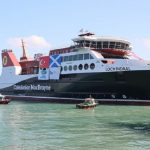
I wanted to take the opportunity in this column to record my particular thanks to our current Minister for Transport, Jenny Gilruth MSP for listening to what islanders are telling her. The decision announced in Parliament by Ms Gilruth on 19th October that two new ferries built to the design of the two new Islay ferries would be ordered this year for deployment to the Little Minch means that we can be optimistic for the future of our mainland connectivity. Three daily return crossings will offer our seafood industry the opportunity to achieve same day connections for shipment to the south of England and the Continent, maximising the export value of our island produce while at the same time guaranteeing a daily middle of the day departure. Our service sector can look forward to tapping a day trip and short stay market from the many visitors who currently come to Skye but don’t make it to the Western Isles.
Another person I believe deserves much credit for recognising the opportunity offered by freeing the Little Minch of the constraint of a single vessel is Kevin Hobbs, Chief Executive of CMAL. CMAL as an organisation has been the subject of criticism for the Ferguson contract award but this predated Kevin’s appointment. I find Kevin is easy to reach, happy to engage – often forthright in his opinions. He is the first person that I think truly understood the opportunity missed by his colleagues and Transport Scotland when they ploughed ahead with the order for 802 rather than seek views from islanders.
I finished my last piece to Am Pàipear by saying “Things can only get better – surely!” I had no reason to think that would be the case so soon. We will still have major issues as ferry reliability is clearly going to be a problem for the time being but at least there is a happy end in sight.
The Comhairle have recently met with Transport Scotland Aviation Division, Loganair Chief Executive Jonathan Hinkles and HIAL at separate meetings to discuss the future of air services to the Western Isles. High on the agenda was the impending sale of Loganair and the PSO contract between Benbecula and Stornoway, which is due to for renewal in April 2023. The Comhairle currently subsidise the five-rotation service by a sum of £600k. This has to be set in the context of increasing costs and a Comhairle Core Budget that has seen a reduction of Scottish Government funding over the last several years. Transport Scotland subsidise a few PSOs including the Barra service but maintain that they cannot support an internal service within a Local Authority Area. They also face having to look closely at their own budget to identify savings.
The discussion with Loganair in relation to the Benbecula/Stornoway service was positive and we outlined the pressure on Comhairle budgets and the need to look at ways that this service could be maintained. The service is particularly essential for the people who have to travel to the Western Isles Hospital for appointments. Currently NHS Eilean Siar refuse to contribute to the costs of running the service, which is disappointing.
In relation to the impending sale of Loganair, which has caused a lot of concern locally, the following points were made by their Chief Executive Jonathan Hinkles:
• Loganair has been serving the Western Isles since 1964 and over that time, the airline has undergone five changes of ownership – Logan Construction Company, the Royal Bank of Scotland, British Midland, Scott Grier and latterly the Bonds. Throughout all of that, services to the islands have continued, ranging from delivering daily newspapers (its first venture to Stornoway in 1964) to being sole operator of the air service at Barra continually since taking over the route from British Airways on 1 September 1974.
• Loganair’s recently-announced return to profit after the pandemic is very helpful ahead of any change of ownership – using the straightforward maxim that “if it ain’t broke, don’t fix it”. If the airline was heavily loss-making, it’s inevitable that any new owner would be seeking to make major changes to stem those losses – which could well have ramifications for island lifeline flights. That isn’t the case as is apparent from Loganair’s performance through the pandemic.
• Equally, the airline needs to make a profit to survive and re-invest. Setting aside the Barra
and the Stornoway-Benbecula routes which are operated as PSO subsidised air services, all of its other Western Isle’s routes – Glasgow to Benbecula and Stornoway, Inverness and Edinburgh to Stornoway – receive no direct public subsidy. Loganair operates these at its own risk, so if it carries no passengers, it receives no income. Of course, the Air Discount Scheme is in place to subsidise fares for non-business trips for island residents, but this is no guarantee of income for Loganair.
• And where fuel prices have shot up, the Scottish Government pays the additional bill for Calmac’s ferries, but Loganair has to recover this through its own means. It also has to invest in its fleet – again, unlike Calmac, there’s no cheque from the Scottish Government to cover new equipment (which many might see as a good thing) and Loganair’s profits are being reinvested into its fleet renewal. The Saab 340 aircraft – the oldest of which G-LGNI is 33 years old, so right up there alongside a Calmac ferry – are being replaced over the next 12 months with next-generation ATR turboprops. The Spiorad de Beinn na Faghla (which is now 32) will be making its last flight for Loganair before year-end.
This replacement programme for equipment used on lifeline air services is being achieved without public subsidy, with minimal fuss (certainly compared to a similar programme on ferries!) and will future-proof the island air services for at least a decade and probably more. Dedicated freighter variants of the new ATR aircraft are already in service delivering the Western Isles’ mail on six days a week into Stornoway and Benbecula, from where the mail is then taken on the inter-isles ferry to Barra too.
• The airline has assured that its fleet renewal programme will continue apace and will not be affected by any impending change of ownership. Its policy of employing staff within the Highlands and Islands – where it supports over 180 full-time jobs – is also set to continue.
• Current shareholders have supported the airline through thick and thin, including the pandemic when they made additional investment into Loganair and strengthened its balance sheet.