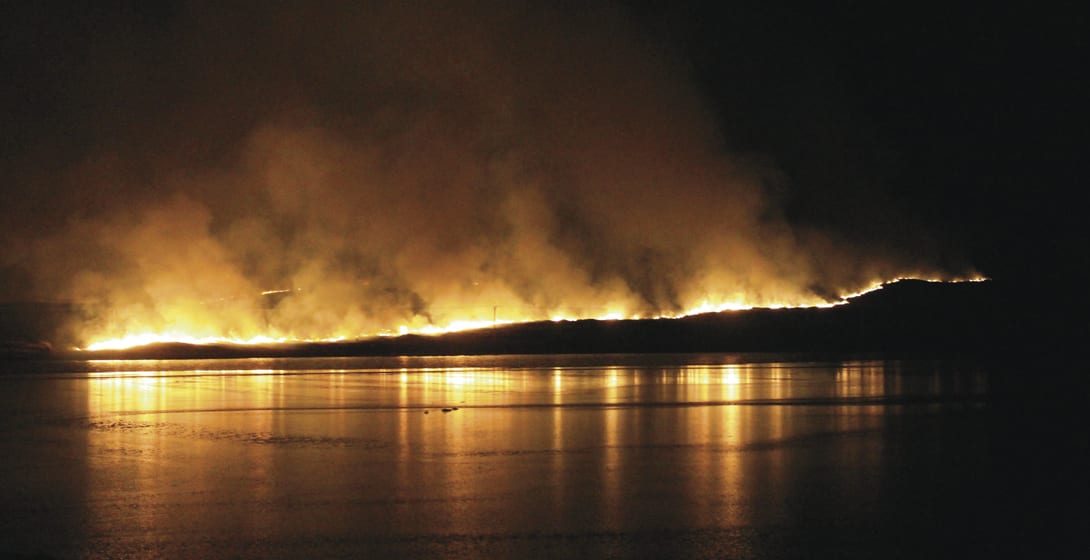
NatureScot is promoting a more environmentally friendly alternative to muirburning after a spate of wildfires in February
Abigail Taylor
Muirburn, permitted between October and April under certain conditions set out in the ‘Muirburn Code’, is the practice of burning heather to encourage fresh growth for game and livestock.
Last month, over two days, fire crews were called to uncontrolled blazes on moorland on the east side of Benbecula, with fires also taking hold around Eaval on North Uist and across a section of Iochdar common grazing on South Uist. While the fires are not all known to have started as muirburn, their occurence has sparked discussion on the practice.
Johanne Ferguson, Operations Manager for NatureScot, explained some of the detrimental effects associated with muirburn: “The fires release huge amounts of carbon dioxide. We’re all extremely concerned about climate change at the minute and as for Uist, it’s experiencing firsthand the effects of climate change.”
Carbon is stored in peat and moss on the hills where the fires take hold. Once burnt, the land can take at least 15 years to regrow to where it needs to be to store carbon released in the air.
“Uncontrolled fires take over and end up burning the blanket bog areas,” continued Johanne. “These areas form the necessary moss to produce peat, so when these areas are cleared by the fires, there is no peat being formed to store the carbon that’s in the air.”
Cutting is being recommended by NatureScot as a way to protect the environment and the wildlife that may be living in the heather and growth that is being burnt. NatureScot staff are in discussion with Stòras Uibhist and common grazings committees and aim to identify areas crofters wish to manage with muirburn so as to promote the method of cutting.
“By cutting instead of burning, we can preserve the moss and peat in the ground, keeping the stored carbon where it should be. If you cut instead of burning, there is material to use again, for example, in composting,” continued Johanne.
Working together with the community, NatureScot staff hope to reduce the need for muirburn and protect the already pressured environment. Rare wildlife thrives in areas of heather, with eagles and other protected species known to nest in the habitat.
Johanne added that while some crofters will continue the practice of muirburn, she urges them to follow the guidance set out on the NatureScot website.
“If they have to burn then they must follow the rules. It is important to note that if people are burning close to nesting protected birds they are committing an offence as they will be disturbing a schedule one bird species.”
Scottish Fire and Rescue service also urged those who wished to continue to burn to follow the rules to prevent further fires getting out of control: “Strict parameters are set for landowners during muirburn period and these include considering factors such as the wind, any wildfire danger warnings that are issued, the nature of the material and having measures in place to prevent escalation. Failing to follow these can lead to rapid fire spread beyond the planned area.”