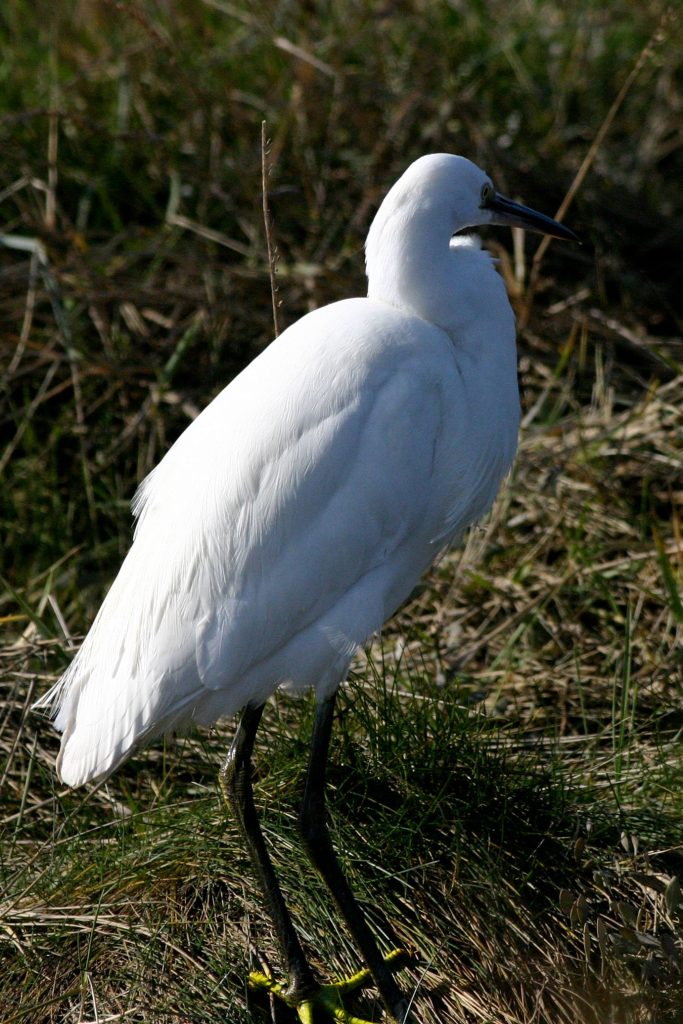
Egrets, I’ve seen a few – every month birdwatchers up here and across the UK take part in the long running Wetland Bird Survey (WeBS). They visit wetland habitats such as estuaries, coasts, lochs, rivers etc to count numbers of waterbirds (ducks, geese, swans, waders, divers, cormorants, herons and usually gulls and terns). I help survey some areas on South Uist and Benbecula and Little Egrets are now regularly seen on our survey counts.
I should apologise for having started with a bad pun and for misquoting Frank Sinatra’s “My Way” but I couldn’t have written this piece about Egrets in 1969 when the song first charted in the UK. At that time Little Egrets were very rare vagrants seen almost exclusively on the south coast of England.
Once widespread across Europe the Little Egret suffered from overhunting in the 1800s as their breeding plumes became prized as a fashionable decoration for hats. As a consequence, the Little Egret became extinct as a breeding species in much of north west Europe and became largely restricted to the Mediterranean area. After gaining widespread protection, and helped by a warming climate, the species began to spread gradually northwards throughout Europe during the 1950s. New colonies became established in Brittany in the 1960s and in the Netherlands, breeding was confirmed in 1979. With birds now breeding close-by on continental Europe, increasing numbers of birds were choosing to winter in the UK.
The numbers visiting the UK each winter rose gradually and then, from the late 1980s onwards there were some quite large influxes of birds along the south coast. Some of them started to summer in the UK and breeding was first confirmed in Dorset in 1996. From there they have spread over much of England and Wales and they first bred in Scotland in 2020. In 2015 it was estimated that there were over 1000 breeding pairs in the UK and the wintering population is now thought to be over 12,000 individuals. The birds we see here are mostly wintering birds but some are now staying into the summer months as well. They haven’t bred here, but who knows, in years to come some may do so.
Other white herons are also doing well in the UK. The Great White Egret, a large Heron sized species, colonised the UK from about 2010 with the first confirmed breeding record in 2012. A pair bred in Scotland for the first time in 2024 at the RSPB’s Loch of Strathbeg reserve in Aberdeenshire. The similarly sized Spoonbill became extinct as a UK breeding bird in 1668 and remained so until a nesting attempt was made in East Anglia in 1999. It now breeds successfully at a number of locations in the east of England and as far north as south Yorkshire. Both Great White Egret and Spoonbill have been seen on South Uist in the last ten years as has the much smaller Cattle Egret.
The lack of trees perhaps makes it unlikely that any of these white herons will breed here. We are all familiar with our Grey Herons, they also nest in trees and breed here so who knows, we may yet be surprised. In the meantime, keep a good lookout for Little Egrets and double check any larger looking white heron-like birds you see.
Robin Sutton – for Curracag and OHBR, 16th March 2026,