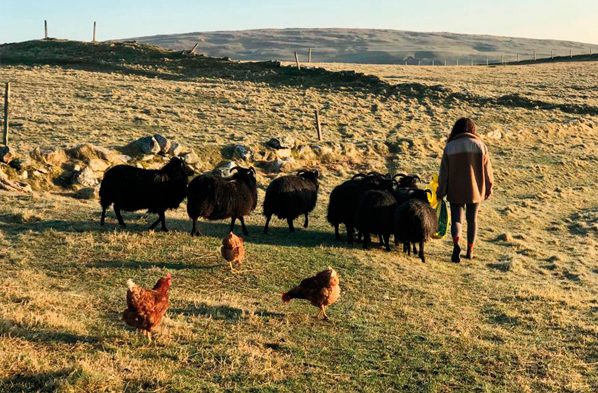
Scanning can be a nervous time for crofters. Have the tups worked? How many ewes are empty? We chatted to a handful of local crofters to find out how they felt before scanning, what results they were hoping for, and how it all worked out.
Duncan MacLean runs a mixed flock on Berneray. Roughly half the ewes are Blackface, tupped with Blackface and Bluefaced Leicester rams, while the other half are cross ewes, run with Suffolk and Beltex cross rams. Chasers follow the main rams to ensure good coverage.
“I would ideally like to be scanning at 150 percent,” said Duncan. “But I’m delighted to have scanned at 136 percent after hearing most people’s percentages are down on the year.
“There are a few more empties than I would like, but they will probably be late as the tups didn’t come in until New Year.”
Mel MacLean keeps mainly Suffolk ewes on her croft in Benbecula. Scanning is integral to the management of her flock, determining the level of feed required for each ewe for the remainder of their pregnancy and which ones may need an extra hand come lambing.
Mel said: “Suffolk ewes can drop weight quickly with lambs onboard, so knowing what they’re carrying helps me judge the quantity of feed to help keep on top of that. I tend to over feed, so I will separate the singles from the twins and triplets who get extra. I lamb inside as quite a few of the ewes will need assistance. Knowing the number of lambs helps me decide my next course of action, once a ewe starts the birthing process.
“Scanning is the start of the build up to lambing, which I love, for the first week anyway!
“My percentage this year was lower than I’ve had in a long time, at 161 percent, but I’ve put this down to a lot of gimmers having singles which suits me fine. I’m very happy with the results.”
Sketch MacAulay has been scanning his Benbecula flock of sheep for 24 years. His ewes are majority Blackface, running with Blackface and Blueface Leicester tups, with the rest, a mix of Texel and Cheviot crosses, put to the Texel.
“For me, scanning is a good help at lambing. It helps if you know what’s in front of you,” said Sketch.
“I’m not too bothered about all the sheep having twins. So long as they have a nice, healthy lamb, that’s fine for me. The main thing is that I know what they’re carrying and that helps me deal with any problems when they’re lambing.”
“It’s been an indifferent year, across the islands, but for me, scanning at 156 percent, I’m very happy.”
Joan MacDonald from Dunskellar said: “Our township had a fairly good scanning. There were 500 sheep done beside Sollas Coop from eight different holdings. Definitely a trend of slightly more empties, fewer twins and very few triplets.
“There was terribly wet weather during tupping. We’re keen to keep empties low, as lamb prices are so good, and an empty sheep is quite a financial loss.
Margaret Cameron from Claddach Kyles commented: “The days leading up to scanning is always nerve wracking as you never know what the results are going to be. It’s outwith your control.
“I think this year there’s a higher percentage of singles throughout and this is possibly a result of poor weather in November when the rams were out. It’s vital that the rams and sheep stay in good condition to make sure they can do their jobs to the best of their ability.
“I was personally very happy with my scanning results. I had a high percentage of twins. I think as a whole on the island everyone was pleased and now we need to look forward to a busy spring!”